
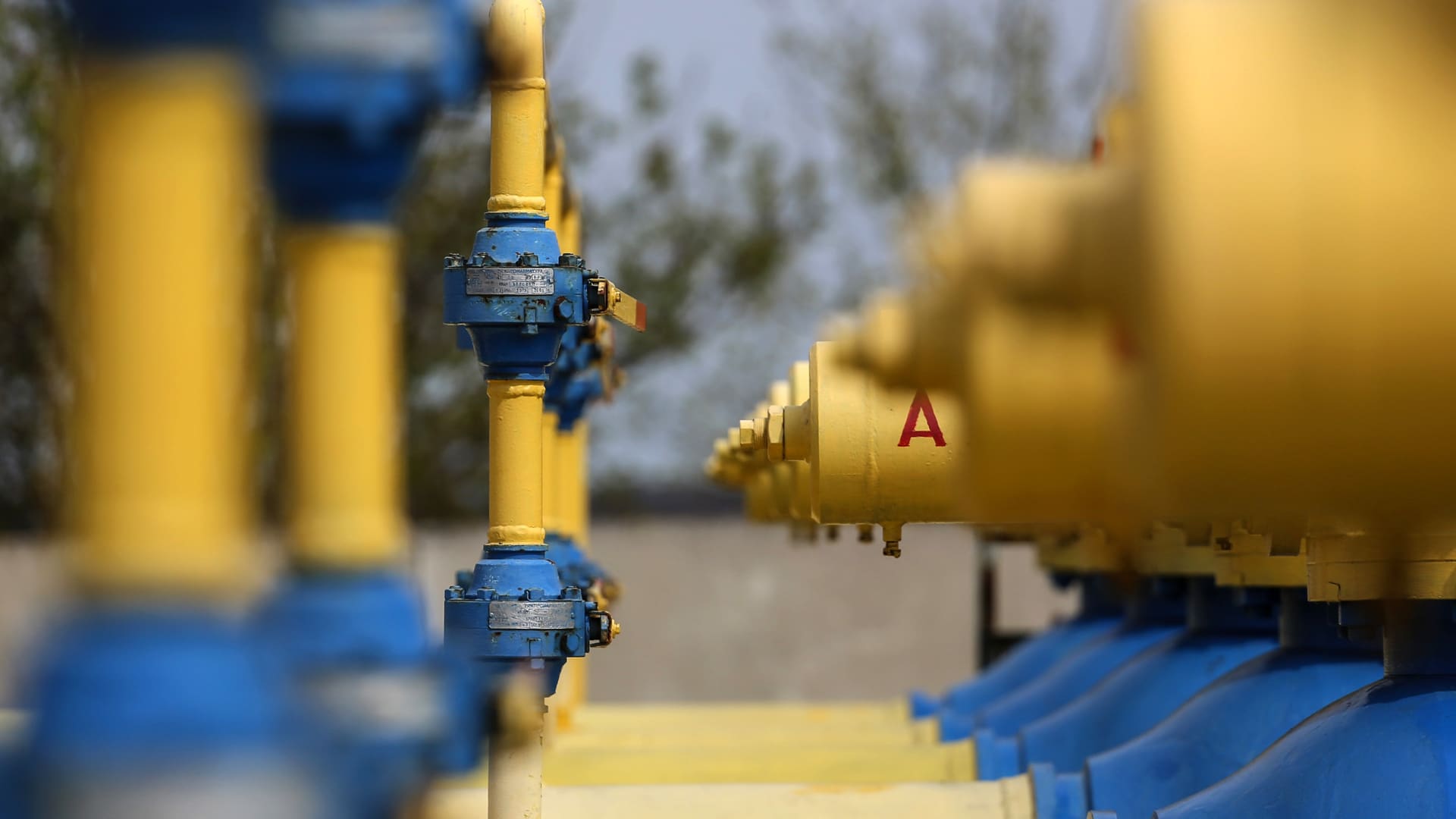

Flow control valves at a natural gas measuring station in Moldova.
Bloomberg | Bloomberg | Getty Images
Moldova's breakaway region of Transnistria has fallen into a deep energy crisis following the cancellation of a five-year gas transit agreement between Russia and Ukraine.
Nearly 500,000 people in the predominantly Russian-speaking region of Transnistria are facing the remaining winter months without heat or electricity after Ukraine halted deliveries of Russian gas to several European countries on New Year's Day.
The widely expected shutdown, confirmed by Russian state energy giant Gazprom on Wednesday, marked the end of Moscow's decades-long dominance of European energy markets.
Along with Slovakia and Austria, Moldova was considered one of the countries most at risk from the suspension of Russian gas deliveries.
The landlocked nation in the northeastern corner of Europe's Balkan region declared a 60-day state of emergency last month over energy security concerns.
Transnistria, a separatist pro-Russian enclave in Moldova, broke up in the early 1990s after the collapse of the Soviet Union but is still internationally recognized as part of Moldova.
Following the disruption of Russian gas supplies on Wednesday, the region has now been forced to close almost all industrial enterprises, with the exception of food producers.
“All industrial enterprises are at a standstill, except those engaged in food production – that is, directly ensuring food security for Transnistria,” Sergei Obolonik, the region’s first deputy prime minister, told a local news channel on Thursday, according to Reuters.
“It is still too early to assess how the situation will develop. … The problem is so big that if it is not solved over a long period of time, we will already have irreversible changes – that is, companies will lose the ability to start.”
“A serious test”
Until Wednesday, Russian gas had reached Moldova via neighboring Ukraine. However, neither Moscow nor Kiev were willing to conclude a new gas transit agreement amid the ongoing war.
Russia, which has been transporting gas to Europe via Ukrainian pipelines since 1991, claims European Union countries will suffer most from the supply shift. Moscow can continue to transport gas via the TurkStream pipeline, which connects Russia with Hungary, Serbia and Turkey.
The European Commission, the EU's executive arm, said it was working with EU member states most affected by the end of the gas transit deal to ensure the entire 27-nation bloc was prepared for such a scenario.
A truck drives over a bridge over the Dniester River toward the unrecognized, Russian-occupied region of Moldova, Transnistria, also known as the Pridnestrovian Moldovan Republic, in Vadul Lui Voda, Moldova, on Oct. 17, 2024.
Pierre Crom | Getty Images News | Getty Images
Moldova, which is not an EU member state but narrowly voted for a closer EU relationship in a referendum last year, is now facing a significant gas shortage.
In Transnistria, the breakaway region's leader Vadim Krasnoselsky said via Telegram on Thursday that the situation was “difficult, but social collapse is unacceptable.”
Krasnoselsky said more than 2,600 facilities in the region are currently without heat and hot water, including more than 1,500 apartment buildings.
He said on Wednesday that Transnistria's main power plant had started using coal after Russian gas supplies stopped, and estimated that the enclave had enough gas reserves to last 10 days of limited use in its northern parts and twice as long in the south .
“In Transnistria, the year began with a serious test – an energy crisis caused by an unfavorable combination of external factors,” Krasnoselsky said, according to a translation.
Elections in Moldova
Moldova's Prime Minister Dorin Recean said this winter must be the last in the country's history in which the country could be held hostage over energy supplies.
The country's parliament said late last year that stopping Russian gas supplies to the Transnistria region could trigger “a humanitarian crisis” as well as “risks to the functioning and stability” of Moldova's energy sector.
Dorin Recean, Moldova's Prime Minister, speaks during the United Nations General Assembly (UNGA) in New York, USA, Friday, September 27, 2024.
Bloomberg | Bloomberg | Getty Images
Moldova lies between Russia and Ukraine and is scheduled to hold parliamentary elections in the coming months. The vote will shape the country's future relations with the EU.
In early November last year, European leaders congratulated pro-Western incumbent Maia Sandu on her victory in the runoff vote in the country's presidential election. The vote was seen as another step in the former Soviet republic's path to integration into the bloc.
— CNBC's Holly Ellyatt contributed to this report.
Comments are closed.