
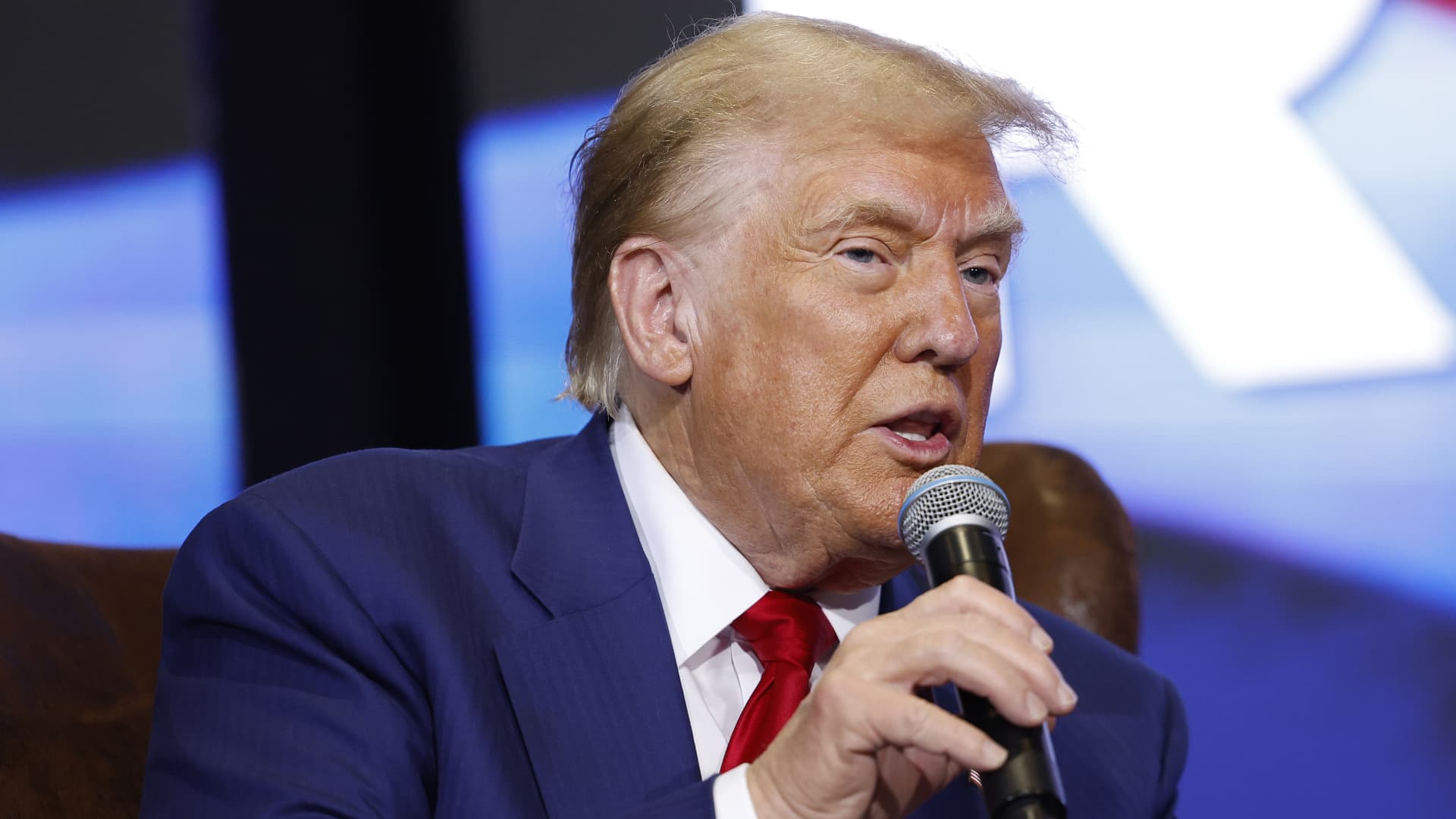
Trump says in an interview with Joe Rogan that he would substitute the earnings tax with tariffs

Former President Donald Trump pushed his idea of eliminating income taxes and replacing them with tariffs in a Friday interview with Joe Rogan, host of one of the world's most listened-to podcasts.
“Did you just float the idea of eliminating income taxes and replacing them with tariffs?” Rogan asked the Republican presidential candidate during their three-hour interview. “Are we serious?”
“Yeah, sure, but why not?” Trump responded.
“We will not allow the enemy to come in and take away our jobs, our factories, our workers and our families unless he pays a heavy price. And the high price is the tariffs,” the former president added.
A central part of Trump's economic policy pitch to voters is comprehensive tax reform, which includes proposals to gut the income tax system and replace it with tough tariff policies.
He has promised to eliminate income taxes on tips, overtime pay and Social Security benefits while renewing his 2017 tax cuts that are set to expire in 2025. He has also said he would consider income tax exemptions for firefighters, police officers, military personnel and veterans.
According to the nonpartisan think tank Tax Foundation, eliminating taxes on tips, overtime and Social Security alone would cost an estimated $2 trillion over 10 years. These costs will only rise if Trump's other tax exemption proposals are added.
Trump sees his aggressive tariff policy as a way to offset these costs.
He has proposed a 20% tariff across the board on all imports from all countries, with a particularly high rate for Chinese imports.
But tax experts and economic analysts don't believe Trump's tariffs would be an adequate counterweight to offset the trillions lost by eliminating income taxes.
“It would not be possible to raise tariffs high enough to cover anything close to that amount.” [of income tax revenue]”Because imports would decline as tariff rates rise,” Garrett Watson, a senior policy analyst at the Tax Foundation, told CNBC earlier this month.
Watson added that Trump's tariffs would likely generate an estimated $3.8 trillion in revenue over 10 years, compared to the $33 trillion individual income taxes would raise over the same period.
All told, Trump's entire tax plan, including tariffs, would add $3 trillion to the deficit over a decade.
“The math doesn’t add up,” said Watson.
Additionally, Trump's tariffs would be paid by U.S. importers, which would increase production costs and could lead to higher consumer prices just as inflation is beginning to cool.
In fact, Trump's tax strategy is based on replacing the income tax with some kind of new sales tax and shifting the tax burden more heavily to low-income people, which Vice President Kamala Harris has used as her own campaign theme.
“It would be a sales tax on the American people,” the Democratic candidate said in an interview with MSNBC’s Stephanie Ruhle in September.
Trump rejected that characterization in a Truth Social post on Thursday, falsely claiming that the tariffs would be “paid for by the abusing country.” Duties or import taxes are paid by US importers.
The Harris campaign addressed her attack in a Saturday memo.
“You protest too much, Mr. Trump,” wrote Ian Sams, Harris’ senior campaign adviser. “Independent experts have found that Trump's plan would essentially be a 'Trump tax' on America's middle class.”
Comments are closed.