

Smoke rises from the site of an Israeli airstrike that targeted a neighborhood in Beirut's southern suburbs early on September 28, 2024.
Fadel Itani | Afp | Getty Images
Hezbollah confirmed that its leader Hassan Nasrallah was killed in an Israeli airstrike in the Lebanese capital Beirut on Friday.
A Hezbollah statement on Saturday said Nasrallah had “joined his great immortal fellow martyrs.” The confirmation came just hours after the Israeli army announced the killing of Nasrallah, following a large-scale attack on Lebanon the day before.
“Hassan Nasrallah is dead,” Israeli army spokesman Lt. Col. Nadav Shoshani said on the social media platform X on Saturday.
The Israel Defense Forces (IDF) said Nasrallah, who led the Iran-backed militant group for more than three decades, was killed on Friday when warplanes carried out what it called a “targeted attack” on Hezbollah's headquarters in Beirut.
In addition to other Hezbollah commanders, Ali Karki, the commander of Hezbollah's southern front, was also killed in the attack, according to the IDF.
Smoke rises as damage is caused to surrounding buildings as a boy is seen on the rubble after Israeli warplanes attacked the Dahiyeh area in Beirut, Lebanon, September 28, 2024.
Houssam Shbaro | Anadolu | Getty Images
The announcement marks a huge blow to Hezbollah after several months of conflict. The IDF said Nasrallah was the group's “central decision maker” and “strategic leader.”
Lebanese political analyst Ronnie Chatah said on Saturday that Hezbollah, which had managed to wield power with absolute authority, become the world's largest paramilitary force and become the world's most sophisticated terrorist organization, was now at its end.
“I think the symbolism cannot be overstated. This is by far the worst psychological blow to this organization since its inception. Hezbollah cannot be the same without Hassan Nasrallah,” he said before Hezbollah confirmed the death.
Chatah said what will emerge in the coming months and years will be “something different,” an organization that will remain intact, “albeit much smaller.”
President Joe Biden called Nasrallah's death in the Israeli airstrike on Saturday “a measure of justice for his many victims, including thousands of Americans, Israelis and Lebanese civilians.”
In the White House statement, Biden also reiterated his support for Israel and his continued calls for a ceasefire and an agreement to release hostages in Gaza. He also reiterated his hope to defuse the conflict in the Middle East, which is on the brink of a full-scale regional war.
“A big gap”
Nasrallah, 64, is considered one of the most influential figures in the Middle East and has played a key role in transforming Hezbollah into a major military and political force.
He has led the Lebanon-based group since 1992, taking over after Israel assassinated the group's former leader, Abbas al-Musawi.
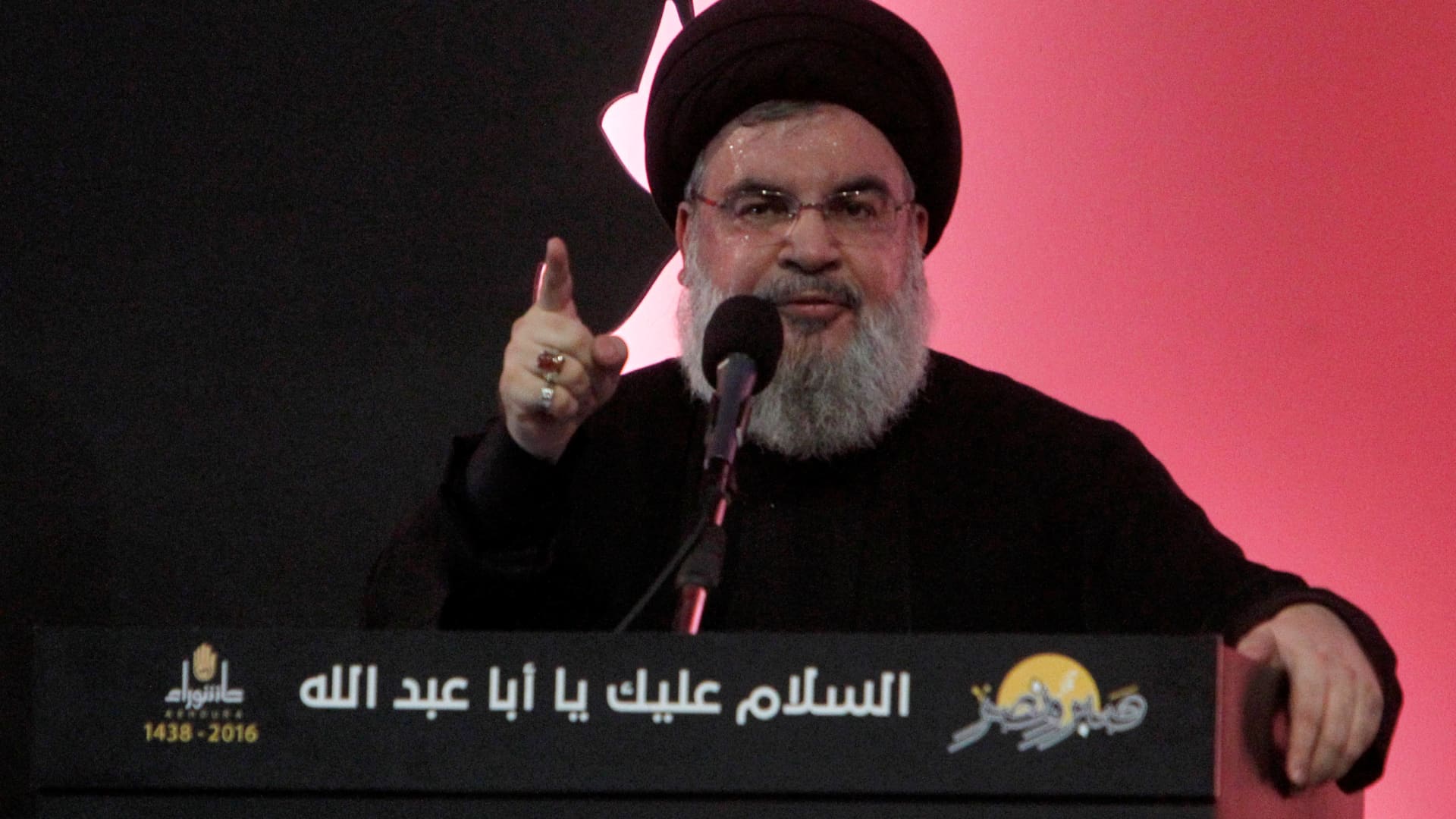
FILE PHOTO: Lebanese Hezbollah leader Sayyed Hassan Nasrallah addresses his supporters during a public appearance at a religious procession, a day before Shiites mark Ashura Day, in the southern suburbs of Beirut, Lebanon, October 11, 2016.
Aziz Taher | Reuters
According to the Council on Foreign Relations think tank, Hezbollah, which is recognized as a terrorist organization by the United States, Britain and other nations, is known to be driven by its violent opposition to Israel and its resistance to Western influence in the Middle East.
Firas Maksad, a senior fellow at the Washington-based Middle East Institute think tank, said on Saturday that news of Nasrallah's killing would have “significant” regional implications.
“Nasrallah was the preeminent and most iconic Arab leader in Iran's regional axis. His assassination is a symbol of a direct confrontation between Israel and Iran over the future of Lebanon and the Levant. This is probably a harbinger of an impending clash, not the end,” Maksad said.
“On the ground, Nasrallah was also the most powerful leader [in] The Shia community in Lebanon. His murder leaves a huge void and triggers serious events [questions] about the community’s future role within Lebanon’s archaic sectarian system,” he continued.
“In the short term, it is likely to exacerbate political polarization and further increase the fragility of a country with a weak central government, leading to further unrest,” Maksad said.
Tens of thousands of people on both sides of the Israel-Lebanese border were forced to leave their homes as a result of the cross-border fire in the months following Hamas' October 7 attack on Israel. Hezbollah has expressed solidarity with the Palestinian Islamist group Hamas.
Israel's leaders have vowed to allow evacuated residents of northern Israel to return to their homes.
“Israel is now waiting to see whether Iran will join in retaliation on behalf of Hezbollah, which will lead to even greater regional escalation,” Nimrod Goren, senior fellow for Israeli affairs at the Middle East Institute, told CNBC.
“But recent developments also provide an opportunity for an exit. With Hezbollah’s power weakened, Israel should finally be ready for a ceasefire in Gaza.”
—CNBC's Emma Graham contributed to this report.
Comments are closed.