
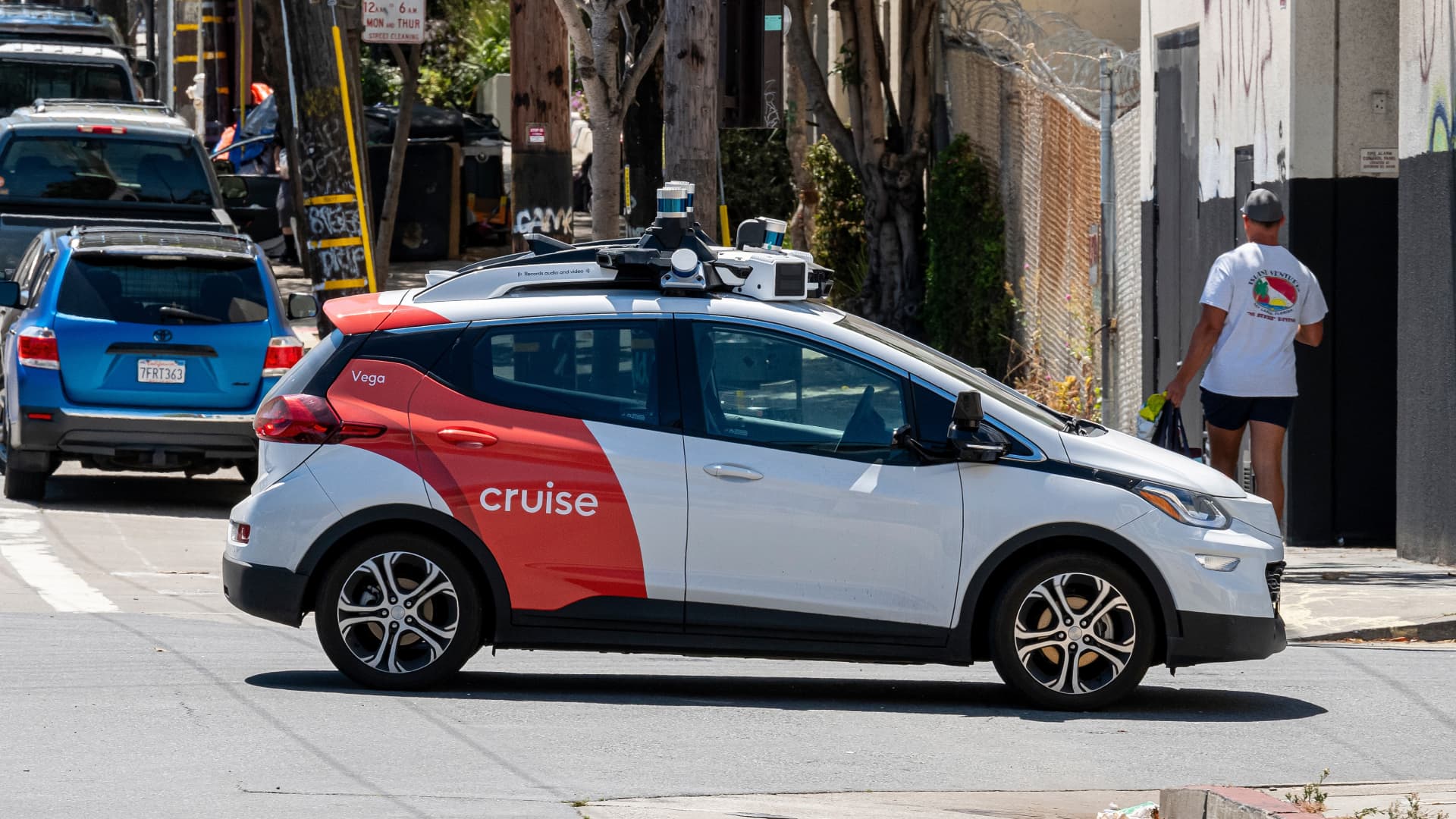

An autonomous cruise taxi in San Francisco, California, USA, on Thursday, August 10, 2023.
David Paul Morris | Bloomberg | Getty Images
DETROIT – For years General Motors CEO and Chairman Mary Barra has promised a new future for the company, moving away from a stodgy, metal-bending automaker to a technology-focused, forward-thinking company poised for growth.
Part of the plan was for GM's innovation department to identify trillions – yes, trillions – of dollars in new market opportunities such as electric commercial vehicles, auto insurance, military defense, autonomous vehicles and, eventually, even the potential for “flying cars.” also known as urban air mobility.
“We are creating world-class technology solutions and services that will transform the way people move, along with new fleet solutions and entirely new business models,” Barra said during a virtual CES keynote in January 2022.
While GM declined to disclose how much revenue those companies generated, Barra made clear with the shutdown of its Cruise robotaxi business on Tuesday that the automaker's growth priorities have shifted amid a broader, industry-wide capital preservation cut. Companies like GM are now focusing on more “core” operations and adjacent business opportunities, including software, electric vehicles and “personal autonomous vehicles.”
“You really have to understand the cost of running a robotaxi fleet, which is quite high and, again, not our core business,” Barra said during a call with Wall Street analysts on Tuesday.
Driverless ride-sharing was supposed to be the shining star of GM's growth opportunity, and executives just a few years ago were calling it an $8 trillion market opportunity that the automaker would lead. That included former executives touting $50 billion in sales by the end of this decade, and Cruise was estimated to be worth more than $30 billion.
After spending more than $10 billion on Cruise since its acquisition in 2016, GM is instead exiting the robotaxi business and folding Cruise's operations and an unspecified number of its nearly 2,300 employees into the automaker.
Save capital
As part of the settlement, GM is expected to disclose additional costs from employee layoff packages and the repurchase of stakes from outside investors, among other costs, next year.
GM cited the increasingly competitive robotaxi market, capital allocation priorities, and the significant time and resources needed to grow the company as reasons for its decision.
The automaker's main competitor was alphabet-backed Waymo, which is now the last company with significant public operations. Others, especially Teslahave ambitions for robotaxi companies, but have not yet been able to commercialize these operations.
To GM's credit, Wall Street, which previously pushed for such growth companies, welcomed the decision to end Cruise's robotaxi ambitions. The company's shares were initially higher before ending the week at levels when the announcement was made.
Stock chart iconStock chart icon
GM stock since December 9, 2024
GM, like other companies, has quickly moved from trying to impress Wall Street with growth initiatives, including generating $280 billion in new business by 2030, to refocusing on its core business amid to generate profits from economic and recession worries.
Analysts largely viewed GM's decision as positive, saving the automaker more than $1 billion in capital annually, which they expected could be used for further stock buybacks, including the goal of reducing outstanding shares to below 1 billion .
“It has been apparent for some time that most investors have removed Cruise from their GM valuations, so today's news is less surprising,” Wells Fargo analyst Colin Langan wrote in a Tuesday investor note.
No more cruises
General Motors CEO Mary Barra speaks during a U.S. presidential visit to the General Motors Factory ZERO electric vehicle assembly plant in Detroit, Michigan, November 17, 2021.
almond and | Afp | Getty Images
GM will combine majority ownership of Cruise LLC with GM's technical teams. Barra said repeatedly last week that the automaker would not abandon vehicle autonomy; The focus is on personal autonomous vehicles rather than robotaxis.
But it's hard to ignore that Cruise is GM's latest mobility project or growth business to fail or fail to live up to expectations.
GM's plans to diversify its business through fashionable verticals like ride-sharing and other “mobility” ventures – a trendy term previously used by the industry for growth initiatives – or startups have largely failed since the automaker began in 2016 to invest in such growth areas.
The automaker integrated its BrightDrop EV commercial vehicles into Chevrolet earlier this year due to weak sales. No meaningful plans for fuel cells to connect to boats, trains and planes have also been announced and several previous “mobility” deals have closed.
Not all of GM's non-core businesses launched in recent years have failed. GM Energy and its BrightDrop commercial electric vehicle unit will continue to operate under the automaker's Envolve fleet business.
GM's finance arm, meanwhile, continues to operate an insurance business that it launched in late 2020 as part of its growth initiatives with its OnStar telematics and data unit. GM said Friday its operations are now in 12 states and remain “well-positioned for long-term success.”
GM also continues to operate a military defense unit and a fuel cell business, both of which recently announced new contracts or partnerships. These include contracts for GM Defense worth hundreds of millions of dollars.
Great cruise
Aside from the capital savings, another positive for GM ceasing Cruise's robotaxi business is that the company sees more promise in further developing its hands-free advanced driver assistance system, Super Cruise. This includes more semi-automatic and ultimately autonomous functions.
GM became the first automaker to offer such a hands-free system in 2016. However, development was extremely slow until the automaker recently started rolling it out across its product lineup. This began in 2021 and was further expanded to more than 20 models, including large-capacity vehicles such as the full-size pickups and SUVs.
Interior of the 2025 Cadillac Optiq with GM's Super Cruise hands-free driver assistance system.
GM
“The change in strategy shows that GM continues to believe in the potential of AV technology for personal vehicles. Going forward, GM will focus on improving SuperCruise's capabilities, further enabled by ongoing technological advances, including artificial intelligence (AI). John Murphy of BofA Securities said in an investor note Wednesday.
On the other hand, Murphy also points out that the move could mean that other companies like Waymo and Tesla “have better technology and/or that the market may not be attractive to later entrants.”
The first mover advantage is lost
GM was not expected to be a “late entrant” to the robotaxis industry. In fact, it was the first company to offer such rides to the public and many believed it was one of the leaders until the company suspended its driverless operations last year in October 2023 after an accident involving a pedestrian in San Francisco.
The National Highway Traffic Safety Administration fined Cruise $1.5 million after the company failed to disclose details of the accident in which a pedestrian was dragged 20 feet by a Cruise robotaxi after being hit by had been hit by another vehicle.
A third-party investigation into the incident ordered by GM and Cruise found that cultural issues, incompetence and poor leadership led to regulatory failures that led to the accident. The investigation also examined allegations of a cover-up by Cruise's leadership, but found no evidence to support those claims.
The report describes several instances in which then-CEO and co-founder Kyle Vogt, who left the company in November 2023, made the final calls to withhold information, particularly regarding the media.
Vogt was not happy with GM's decision to end robotaxi operations. After the announcement, he wrote on X: “If it was unclear before, it's clear now: GM are a bunch of fools.”
Vogt pointed out earlier this year that GM has had a first-mover advantage in technology in the past, as was the case with Cruise and Super Cruise, and then squandered it. GM followed a similar path with EV technology, such as the EV1 – a battery-electric vehicle manufactured in the 1990s – and the Chevrolet Volt plug-in hybrid electric vehicle in the 2010s, both of which were abandoned by the company.
GM follows several other companies in ditching robotaxis, including its closest downtown rival Ford enginewhich shut down its Argo AI autonomous vehicle unit with Volkswagen in 2022.
The robotaxi market leader in the US remains Waymo, which continues to expand operations of its public fleet in Los Angeles, Phoenix and San Francisco and will soon debut in Miami, Atlanta and Austin, Texas.
“This announcement in many ways highlights the economic challenges of building out a robotaxi network and the role that ride-sharing platforms can play in the commercialization of AVs (an optimistic indicator), but we believe the more tangible implications are currently being seen on the partnership ecosystem “Already scaling despite costs and Tesla also has ambitions to do so,” Bernstein analyst Daniel Roeska said in an investor note last week.
Comments are closed.