

Enlarge iconOutward pointing arrows
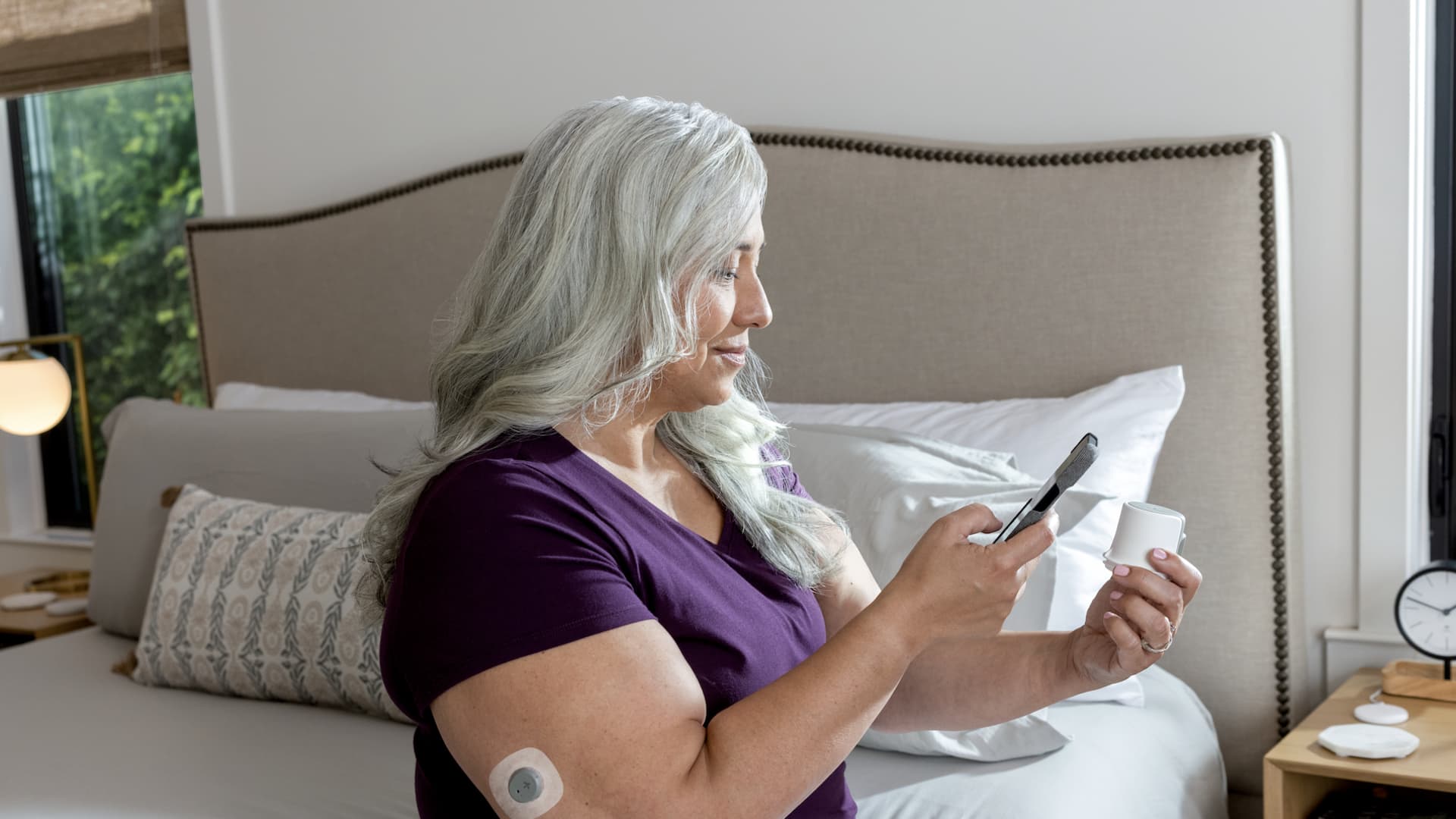
User wears Stelo CGM by Dexcom.
Courtesy of Dexcom
Dexcom announced Monday that its new over-the-counter continuous glucose monitor Stelo is officially available in the U.S.
Glucose is a type of sugar that humans get from food and is the body's main source of energy. Continuous glucose monitors (CGMs) are small sensors that are inserted through the skin to measure glucose levels in real time. They are usually prescribed to patients with diabetes because they can help alert the patient, their loved ones, and their doctor to emergencies.
Stelo is primarily intended for patients with prediabetes or type 2 diabetes who do not use insulin, although it is also available for people without those conditions. Users can purchase a month's supply online for $99 or subscribe for $89 per month.
Dexcom said in a statement that patients also have the option to use their flexible spending accounts and health savings accounts to pay for Stelo.
The company already offers continuous glucose monitors for patients with Type 1 and Type 2 diabetes, but Stelo is Dexcom's first product that doesn't require a prescription. While most patients with Type 1 diabetes can already get health insurance to cover the sensors, Stelo is now accessible to millions of patients with Type 2 diabetes who previously couldn't get a prescription or health insurance. It's also the company's official foray into a new and potentially lucrative prediabetes market.
Dexcom said in a statement that there are more than 125 million Americans with prediabetes or type 2 diabetes who do not use insulin. The company developed Stelo to teach this group of patients how to keep their glucose levels in a healthy range.
“The idea is to help people learn more about dietary habits and preferences over time and how those affect blood sugar,” said Jake Leach, chief operating officer at Dexcom, in an interview with CNBC. “It's about uncovering things you've never seen before and then using those to develop healthier habits.”
How it works
The US Food and Drug Administration (FDA) approved Stelo in March. It was the first over-the-counter continuous glucose monitor to be approved for use, although Dexcom’s competitor, Abbottreceived approval for two similar devices in June.
Leach said Dexcom is working with Amazon to make Stelo deliveries. Users with a subscription can skip or adjust their delivery date, but it will typically be scheduled at 30-day intervals from their first login.
Stelo is worn on the upper arm and lasts 15 days before needing to be replaced. It is gray, about the size of a quarter and about half an inch thick.
The sensor transmits data wirelessly to a smartphone app. During setup, users can select whether they have type 2 diabetes, prediabetes, or neither. This helps set their “target range” where Dexcom wants users' glucose levels to stay. The target range is based on established medical standards and is between 70 and 180 milligrams per deciliter for most people, according to the American Diabetes Association.
When they open the Stelo homepage, they'll see their most recent reading, which is updated every 15 minutes. They'll also see a graph of their daily readings, which includes a green shaded area indicating the target range. If they scroll down, they'll see a summary of the time they've spent in the target range over time.
Everyone's glucose levels are different, but Stelo sends users an alert when a significant spike occurs. Glucose spikes occur when the amount of sugar in the bloodstream rises quickly and then falls again. This often happens after eating.
In the short term, spikes can cause fatigue, but over time, high glucose levels can lead to more serious health problems, such as diabetes, heart disease and kidney disease, according to the Centers for Disease Control and Prevention. For this reason, Dexcom wants users to try to keep their levels within Stelo's target range.
The tab next to the home page is the Events page, where Stelo users can log meals, activities, finger pricks or other notes. Leach said it's most important for users to log an entry when they experience a big spike so they can reflect on what might be causing it.
Stelo notifies users of notable spikes, so they won't necessarily be notified every time their levels go up. Leach says this is a conscious design decision meant to draw attention to the larger fluctuations patients experience.
“Even for someone whose blood sugar is normal and who has occasional spikes, the system looks for the biggest spikes and then tries to reach out to the user and say, 'OK, what happened there?'” he said.
And for users who want to delve deeper into their blood sugar and understand the causes of blood sugar spikes, there is a wealth of educational materials available in the app's Learn tab. The articles are short, sometimes just a few sentences long, and they're divided into categories like “Stelo Basics,” “Glucose in Depth,” “Diet,” “Exercise,” “Sleep,” and “Stress.”
CNBC tests Stelo
Enlarge iconOutward pointing arrows
The Stelo app
Courtesy of Dexcom
I've been testing Stelo since the beginning of August. Overall, I find it easy to use and helpful.
When my monitors arrived in the mail, my first task was to attach the sensor to my arm and pair it with the Stelo app. This process was very straightforward for me – the app guided me through each step with clear step-by-step instructions.
I cleaned the back of my right arm, placed the Dexcom applicator there, pressed the button, and the CGM turned on immediately. It's quick and doesn't hurt at all.
The monitor connects to the Stelo app via Bluetooth and then takes about half an hour to warm up.
This is where I initially encountered some issues. After my device warmed up, I received an error message saying “Temporary sensor issue”. The message told me not to remove the CGM and that the issue was only temporary. I left it on all day, but by the evening I noticed a slight bleeding. I decided to remove the sensor.
I attached another CGM to my other arm, which warmed up and worked fine. I've been wearing it ever since and haven't had any issues with bleeding. Leach said if users have any issues with the product, they can send a message to the chat interface on Stelo's website to get a replacement device or have their questions answered there.
After I got my second sensor set up and running, everything went smoothly.
I found the Stelo app simple and easy to use. I never felt like I was overloaded with too much data or too many notifications, and logging meals and exercise is very straightforward. Users can also import their sleep and activity data from the Apple Health app or Android's Health Connect app, which I think is a nice touch.
If this is your first time using a CGM, I definitely recommend reading through the articles on the Learn tab. I think Dexcom does a great job of explaining in simple language what glucose is, what it affects, and why it's important.
The longer I wear the sensor, the more I can tell that the algorithm is adapting to me and my habits. I don't get notified every time my blood sugar spikes, but I get alerted when there's a particularly sharp rise. The app is also starting to recognize my patterns. For example, it recently told me that my blood sugar spikes between 5 and 7 p.m., which is around the time I eat dinner.
Most of the time I even forget that I'm wearing a sensor. It's waterproof, so I didn't have to worry about it when I was showering. And I didn't notice it when I was sleeping. I would advise a little caution when putting on long-sleeved clothes, as the sensor can get caught a little, but you can wear all kinds of clothes and jackets over it without any problem.
In the short time I've been using Stelo, I've learned a lot about how my body reacts to certain foods. Even small adjustments (eating carbs last, for example) have helped me reduce spikes. It's easy to see how CGMs can serve as a valuable window into the body. If you're looking for a simple, accessible way to start understanding your glucose data, I think Stelo is a solid option.
Comments are closed.