
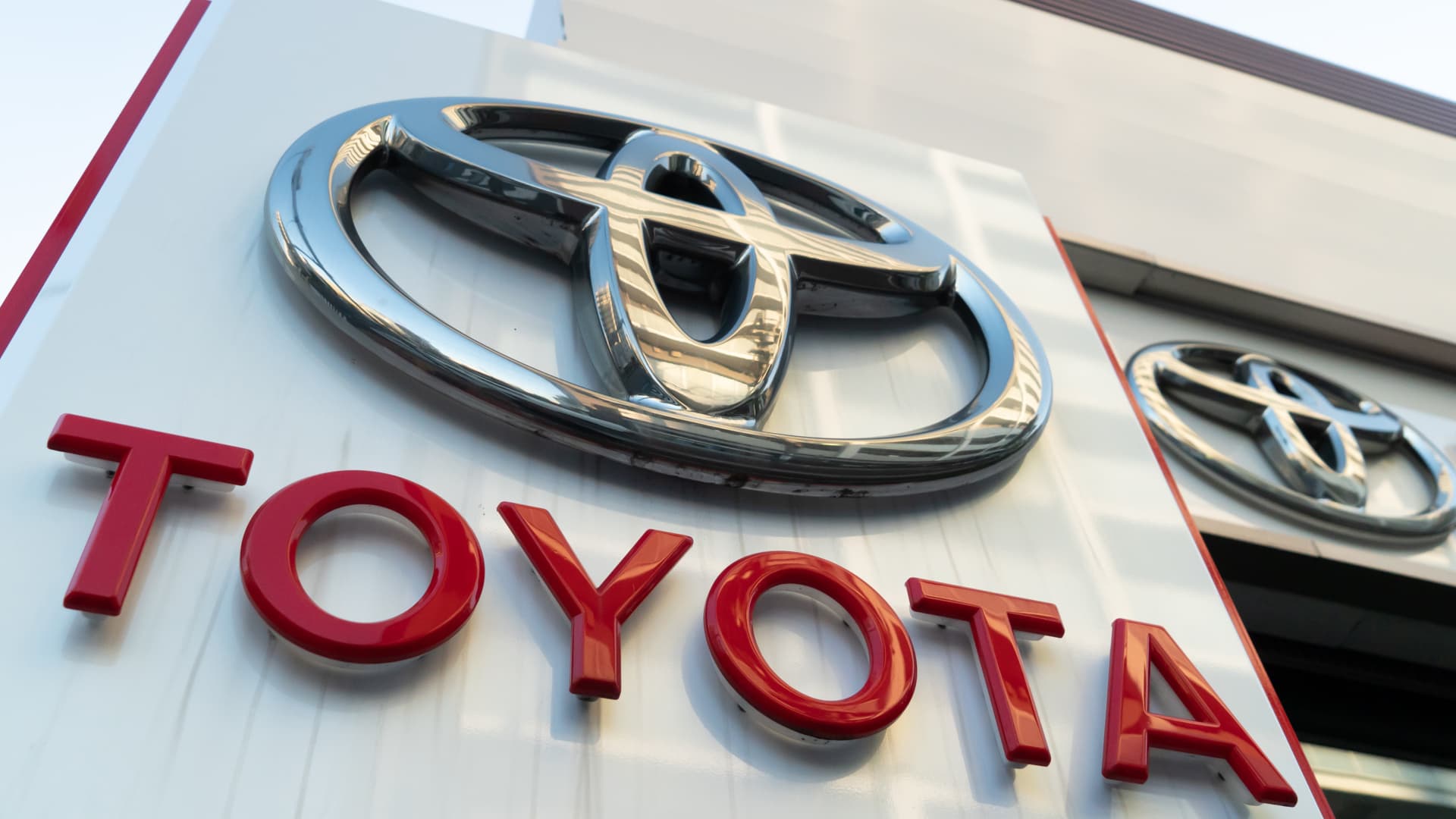

A sign is posted outside a Toyota Motor Corp. dealership in Tokyo, Japan, on January 30, 2024.
Tomohiro Ohsumi | Getty Images News | Getty Images
DETROIT – Toyota engine sounded the alarm Friday that California-led electric vehicle regulations set to take effect next year are “impossible” to comply with and, if not changed, will lead to less choice for customers in several states.
Current requirements under the California Air Resources Board's Advanced Clean Cars II regulations call for 35% of 2026 model year vehicles, which begin introduction next year, to be zero emission vehicles (ZEVs). Battery electric vehicles, fuel cell vehicles and, in some cases, plug-in hybrid electric vehicles are considered emission-free according to the regulations.
“I have not seen a forecast from anyone – government or private – that has told us that this number is achievable. At this point it looks impossible,” Jack Hollis, chief operating officer of Toyota Motor North America, said during a virtual media roundtable on Friday. “The demand is not there. This will limit the customer’s choice of the vehicles they want.”
The California Air Resources Board reports that twelve states and Washington, DC have adopted the rules. About half of them did so starting with the 2027 model year. The EV regulations are part of CARB's Advanced Clean Cars regulations, which require that 100% of new vehicle sales in the state of California be zero-emission models by 2035.
JD Power said no state has yet complied with the EV mandate this year. Only California (27%), Colorado (22%) and Washington (20%) accounted for at least 20% of retail sales this year for electric vehicles or PHEVs. Other states such as New York (12%), New Mexico (5%) and Rhode Island (9%) are far from compliant.
The national average of EV/PHEV retail adoption is just 9% through October, JD Power said Friday.
Hollis said if the rules remain unchanged, it will lead to “unnatural actions” in the auto industry that have already begun at some automakers, where companies are supplying a disproportionate number of electrified models to states that have agreed to the rules.
“It will distort the industry. It will distort business. Why? Because it’s unnatural for the current demand in the market,” said Hollis, a longtime automotive executive.
Several automotive insiders previously told CNBC that the EV mandate issue needed to be addressed regardless of who won the election this year.
The California Air Resources Board did not immediately respond to a request for comment.
President-elect Donald Trump's first term saw a legal battle to strip states of the ability to set their own emissions standards. Several officials expect Trump to continue this push once he is back in the White House.
Hollis said he “hopes it doesn't come to that this time” and that states, the federal government and the auto industry can come to a solution. He also said Toyota would prefer a national standard – a sentiment previously shared by many automakers.
“We would always want a 50-state rule because that way we can treat all customers, all merchants equally, fairly, whatever that may be,” Hollis said. “Our hope would be that California and [the Environmental Protection Agency] would fit together and be reduced to something that is achievable. Even if it is a push, even if it is a reach, but at this point it is an impossible phase.”
Comments are closed.