
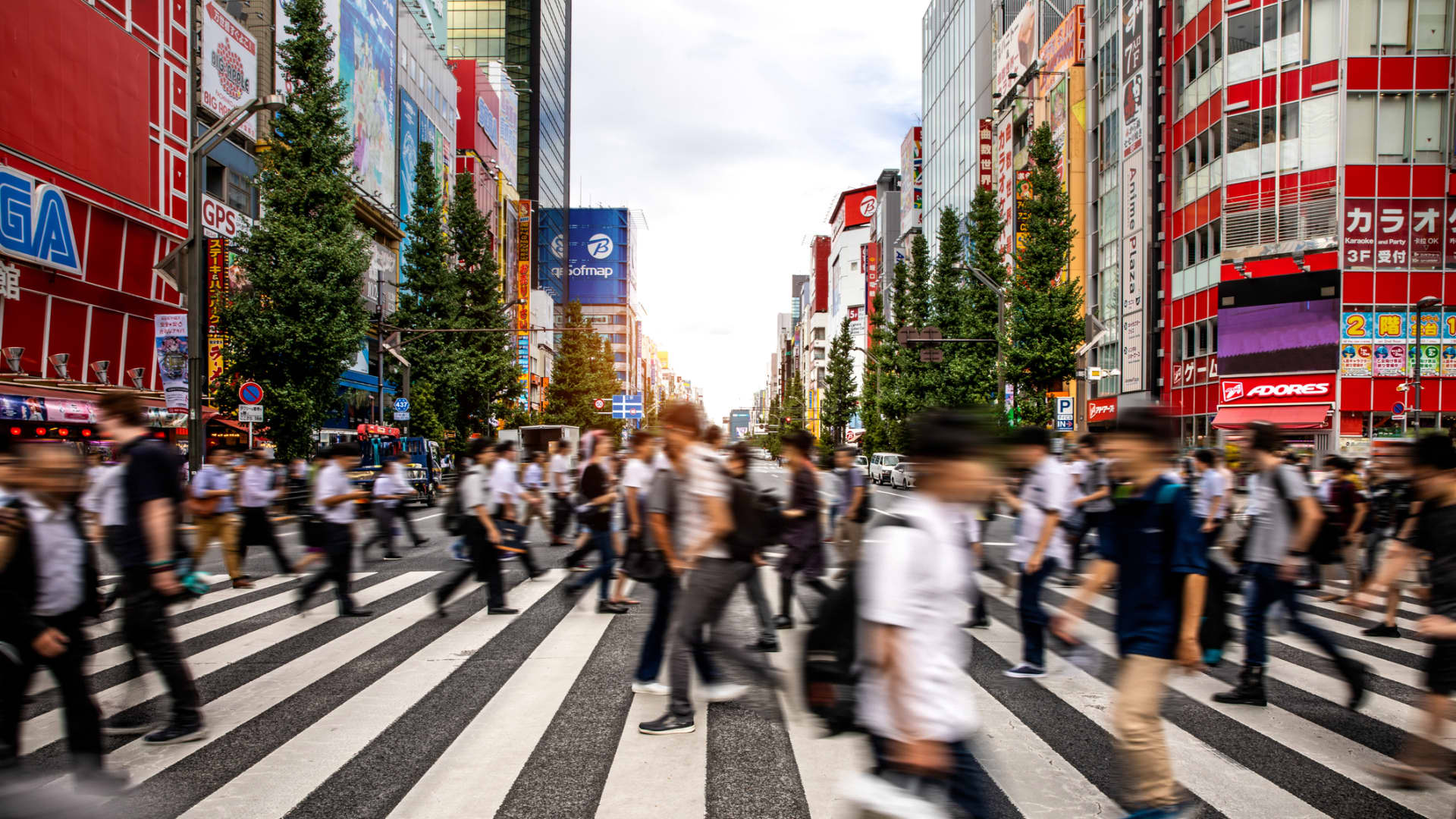

People cross the street in Tokyo's busy downtown district of Akihabara
Leopatrizi | Istock | Getty Images
Japan marked its “Respect for Elders Day” earlier this week, with the national holiday highlighting a somewhat problematic fact: the country has a record number of elderly citizens to celebrate.
Government data released ahead of the event showed that Japan's population aged 65 and over rose to a historic high of 36.25 million.
While the country's overall population is declining, the proportion of people over 65 has grown to 29.3 percent of the population, the highest proportion of any country, according to the Statistics Office of the Ministry of Internal Affairs and Communications.
According to Robert Feldman, senior advisor at Morgan Stanley MUFG Securities, the data further fuels concerns about demographic changes and a labor shortage in the country.
A survey by Teikoku Databank last month found that 51% of companies across all industries in Japan feel there is a shortage of full-time employees.
“The labor shortage is as bad as ever,” says Feldman, pointing out that it is particularly noticeable in labor-intensive industries such as the restaurant industry.
Meanwhile, the number of Japanese workers aged 65 and over rose for the 20th consecutive year in 2023, reaching a record 9.14 million, according to data from the statistics bureau.
Feldman warned that these older workers who retire will not be replaced by younger workers in equal numbers.
No universal solution
According to recent trends, the proportion of elderly people in Japan is expected to continue to rise, reaching 34.8 percent in 2040, according to the National Institute for Population and Social Research.
Meanwhile, Morgan Stanley's Feldman estimates in a recent study that, based on past demographic trends, the total workforce could fall from around 69.3 million in 2023 to around 49.1 million in 2050.
The Japanese government has recognized the economic and social damage these trends can cause and has taken measures to counteract them.
Several measures are aimed at reversing the country's declining birth rate. Prime Minister Fumio Kishida's office has implemented policies including allocating more funds for child-rearing and supporting more childcare facilities in the country.
Local governments have even taken steps to support public dating apps aimed at encouraging Japanese people to socialize, marry and have children.
However, an increase in the birth rate is unlikely to solve the labor shortage in the short term. Japan has therefore been steadily opening up to more immigration in recent years. According to local media reports, the number of foreign workers will reach a record two million in 2024, and up to 800,000 more are planned over the next five years.
According to Feldman, in order to offset the expected population losses in the coming decades, the country will have to hire foreign workers much more quickly – in the tens of millions.
“I don't think that's going to happen. That means a lot of the decline in the domestic labor force will have to be offset by higher productivity among the young people who will stay,” Feldman said.
Achieving this productivity growth among workers will require more investment in their productivity and the implementation of new technologies such as AI and automation, he added.
Carlos Casanova, chief Asia economist at UBP, told CNBC's “Squawk Box Asia” earlier this year that AI technology is often cited as a solution to Japan's demographic crisis, but has so far done little to alleviate it.
“We live in a society that is increasingly consumer-oriented. To maintain economic dynamism, we need a large workforce that earns and spends money,” said Casanova.
“AI can be part of the solution, but there are other things they need to do,” he added, suggesting that in addition to immigration, the country should work on social and structural changes, such as increasing female labor force participation.
Comments are closed.