
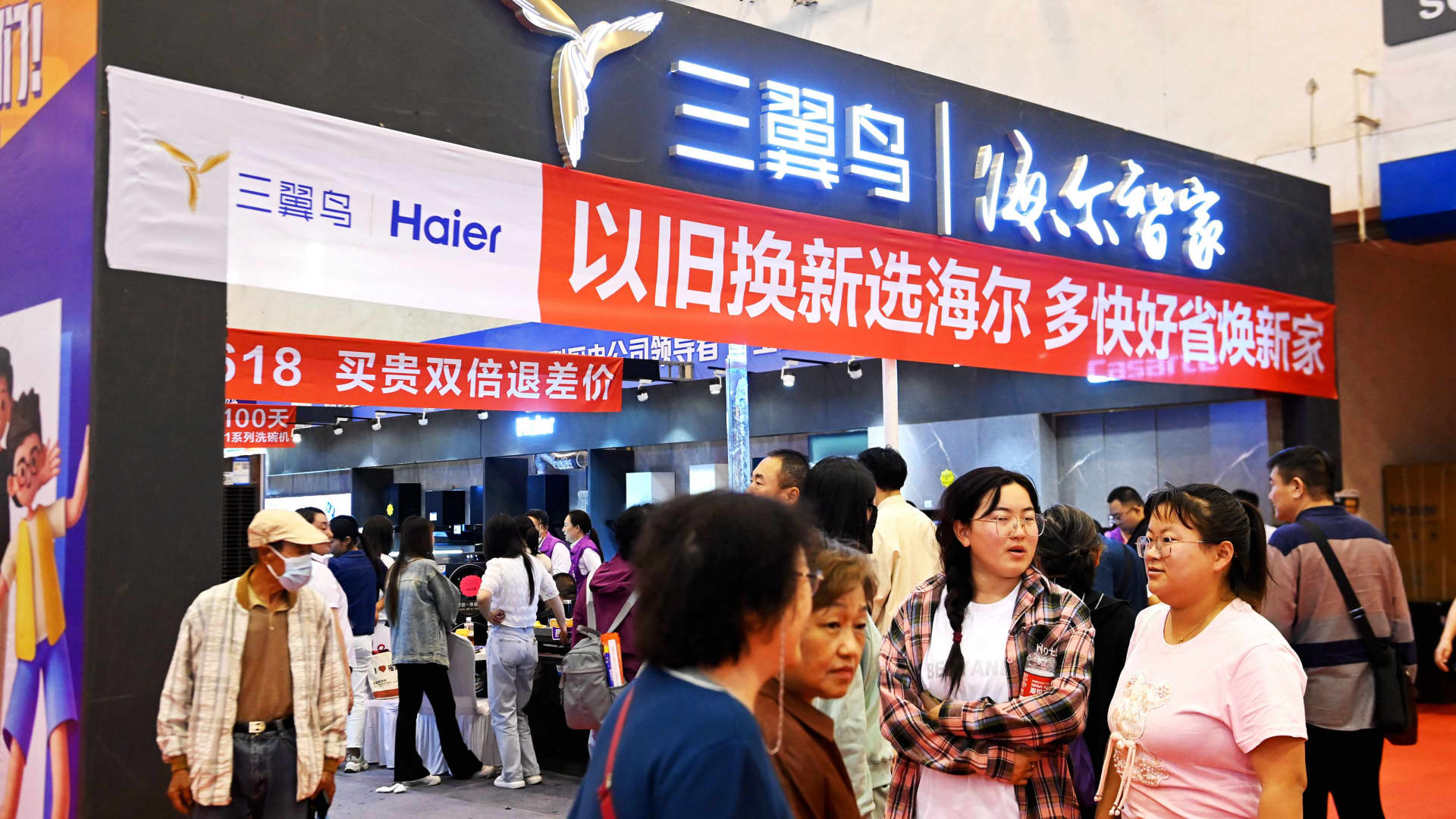

A banner advertises China's trade-in policy at a home goods fair in Qingdao, China's Shandong province, on June 1, 2024.
Nurphoto | Nurphoto | Getty Images
BEIJING — China's plan to boost consumption by encouraging trade-ins has yet to show significant results, several companies told CNBC.
In July, China announced the issuance of 300 billion yuan ($41.5 billion) in special ultra-long-term government bonds to expand its existing trade-in and equipment upgrade policies in an effort to stimulate consumption.
Half of that amount is earmarked to subsidize trade-ins of cars, appliances and other expensive consumer goods, while the rest is earmarked for upgrading large equipment such as elevators. Local governments can use the ultra-long-term government bonds to subsidize certain purchases by consumers and businesses.
While the targeted move to boost consumption surprised analysts, these measures still require China's cautious consumers to spend some money up front and have a used product to trade in.
“We are not aware of any company where this has translated into concrete incentives on the ground in China since the measures were announced,” Jens Eskelund, president of the EU Chamber of Commerce in China, told reporters earlier this week.
“Our encouragement would be that we now focus on implementation [for] visible, measurable results,” he said.
The Chamber's analysis found that the total budget of the central government's policy is about 210 yuan (US$29.50) per capita. Given that “only part of the [it] will reach private consumers, it is unlikely that this program alone will significantly increase domestic consumption,” the organization said in a report published on Wednesday.
Analysts are not overly optimistic about the extent to which the trade-in program could support retail sales.
Tao Wang, chief China economist at UBS Investment Bank, said in July that the new trade-in program could support about 0.3 percent of retail sales in 2023.
China's retail sales for August will be released on Saturday morning. Retail sales rose 2% in June, the slowest growth since the Covid-19 pandemic, while sales growth improved slightly in July at 2.7%.
However, according to industry data, sales of alternative-fuel vehicles rose by almost 37 percent in July, despite a decline in overall car sales.
The trade-in scheme more than doubled existing subsidies for the purchase of vehicles with alternative propulsion technology and conventional fuels, to 20,000 yuan and 15,000 yuan per car respectively.
Waiting for the elevator modernization
In March and April, China had already begun to introduce measures to comprehensively support equipment upgrades and exchanges of consumer goods. As part of the measures announced in late July, officials noted that 800,000 elevators in China had been in use for more than 15 years, and 170,000 of them had been in use for more than 20 years.
Two major foreign elevator companies told CNBC in August that they had not yet received any concrete new orders under the new program to modernize their equipment.
“We are still at a very early stage of this whole program,” said Sally Loh, president of the China business of US elevator maker Otis. The companies know the total amount, she said, but “how much will be allocated for elevators is not really clear yet.”
“We certainly see that there is a great deal of interest from local government to ensure that this type of funding from central government is used effectively for the housing that most needs this replacement,” she said, noting that the announced funds “really help to address some of the funding issues that are a great concern for our customers.”
Otis's sales in China fell by double-digit percentages in the second quarter, according to an earnings release. Sales were not broken down by region.
Finnish elevator maker Kone said its sales in Greater China fell more than 15% year-on-year to 1.28 billion euros ($1.41 billion) in the first six months of 2024, reflecting the real estate crisis. That was still more than 20% of Kone's total sales in the first half of the year.
“We are certainly excited about this opportunity. We have been excited about it for a long time,” said Ilkka Hara, Kone's CFO. “This is more of a catalyst that will enable many to make this decision.”
“I definitely see opportunities in the future,” he said. “How quickly they will materialize is hard to say.”
Hara pointed out that new elevators could save more energy compared to older models and said that in addition to sales, Kone also wants to expand its elevator service business.
Outlook on the used market
It may take some time for the central government's measures to be implemented locally. Several major cities and provinces have only announced details in the last few weeks about how the trade-in program would work for residents.
For ATRenewwhich operates used goods refurbishment businesses, the ultra-long government bond program to support trade-ins will have no short-term impact, said Rex Chen, the company's chief financial officer.
However, he told CNBC that the measure supports the longer-term development of the used goods market and that he hopes there will be more government support for the construction of trade-in kiosks in residential areas.
ATRenew focuses on pricing and reselling select used devices – the company says it became Apple's trade-in partner in mainland China last year.
In certain categories and regions – such as mobile phones and laptops in parts of Guangdong province – trade-in volumes have actually increased this summer, Chen said.
According to ATRenew, which did not give an exact time period, trade-in orders through e-commerce platform JD.com have increased by more than 50% year-on-year since the new policy was introduced.
— CNBC's Sonia Heng contributed to this report.
Correction: This story has been updated to clarify that ATRenew is Apple's trade-in partner in mainland China.
Comments are closed.