
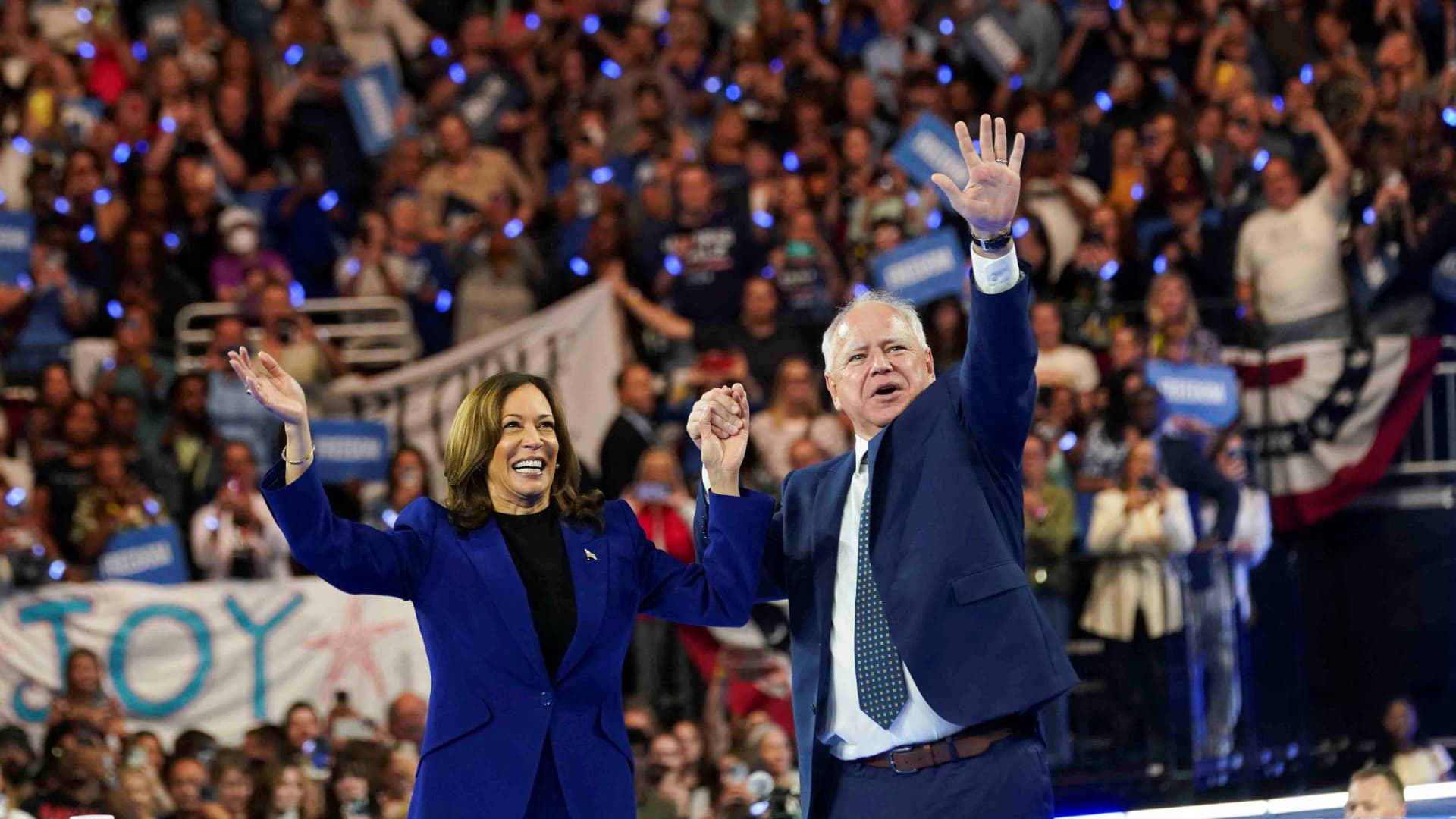

U.S. Vice President and Democratic presidential candidate Kamala Harris and her running mate, Minnesota Governor Tim Walz, gesture at a campaign rally in Milwaukee, Wisconsin, U.S., August 20, 2024.
Kevin Lamarque | Reuters
To understand presidential candidates Harris-Walz's economic vision, Minnesotans say one only has to look at the North Star State.
“I've heard some of the things that were discussed on the ballot,” Bernie Burnham, president of the Minnesota AFL-CIO, said in an interview with CNBC. “They kind of reflect what's happening here.”
Under Democratic Governor Tim Walz, Minnesota has expanded union protections, released over a billion dollars for housing, implemented universal paid family and medical leave, funded free school meals, raised corporate taxes, and more.
Taken together, they make Minnesota a testing ground for progressive policies that have faced resistance at the federal level.
And now that Walz is running as Kamala Harris's vice presidential candidate, Minnesota's strategy is attracting national attention.
“It’s definitely a roadmap,” Amy Koch, a Republican strategist and former Minnesota state senator, told CNBC.
Already, several of Harris' campaign's economic priorities reflect the policies Walz championed in Minnesota.
The vice president has proposed codifying stronger worker protections, investing in building three million new homes, providing a $25,000 grant to all qualified first-time homebuyers, and expanding the child tax credit, earned income tax credit and other tax programs. She has also advocated raising the corporate tax rate.
But at the same time, Harris has toned down the rhetoric about corporate greed and corporate monopolies that has featured in so many of President Joe Biden's speeches.
This raises hopes among some American business leaders that, if elected president, Harris could give them a bigger seat at the negotiating table than her predecessor.
But if Harris follows Walz's approach in Minnesota, that hope may be nothing more than a pipe dream.
“Beware of the wind”
Walz's progressive policy agenda swept through the Minnesota Legislature at lightning speed, with the lion's share passed within the first few months of 2023, when he began his second term.
This was made possible by the confluence of a rare set of factors that benefited the Democrats.
When Walz was re-elected as governor of Minnesota in November 2022, the state's Democratic Party, known as the Democratic-Farmer-Labor Party (DFL), won a triple victory with razor-thin majorities: one seat in the Senate and six seats in the House of Representatives.
Democratic gubernatorial candidate Tim Walz participates in a roundtable discussion on gun violence prevention with former Rep. Gabby Giffords on October 26, 2018 in Minneapolis, Minnesota. This photo was taken on October 26, 2018.
Brian Snyder | Reuters
“I'll be honest, it was a bit of a surprise,” said Jeff Hayden, a former DFL senator from Minnesota. “We all kind of gasped,” he told CNBC.
A month later, there was more good news for the new DFL majority.
The Minnesota Office of Management and Budget reported that the state will enter the 2023 legislative session with a budget surplus of $17.6 billion. It was the largest single-year budget surplus in Minnesota history, the result of high tax revenues and lower-than-expected spending.
The DFL now had both the necessary voting majorities and the necessary money to implement its program.
The Democrats in Minnesota also realized how fragile their triple victory was.
The Land of 10,000 Lakes is reliably dominated by Democrats in presidential elections. But it's far less partisan at the state level. The last time Democrats won both houses of the legislature and the governorship in Minnesota was in 2012, and they promptly lost that three-way in the following election cycle.
Minnesota Democrats were still fresh in the memory of their 2014 defeat and knew they might have only months to turn their priorities into legislation.
“People just threw caution to the wind,” Hayden said.
During his second term, Walz signed several important pieces of legislation, including a $2.3 billion education budget, as well as measures to enshrine abortion access and transgender protections, legalize marijuana, expand housing benefits and child care tax credits, strengthen collective bargaining rights for workers, fund free school meals, and ban so-called corporate “junk fees.”
Resistance from industry
The political push for Minnesota's universal paid family and medical leave, which Walz signed into law last year, was largely driven by unions and progressive advocacy groups.
“We had a very important seat at the table,” said Elianne Farhat, executive director of TakeAction Minnesota, a progressive nonprofit. “It was really a good model and a way to achieve what we would call shared governance: community and elected officials.”
But Walz had to balance those interests with pressure from Minnesota's significant business community, which the state is very proud of. More than a dozen Fortune 500 companies have their headquarters there, including Goal, General Mills And UnitedHealth.
The Target flagship store at Target headquarters on January 7, 2021 in Minneapolis, Minnesota.
AaronP/Bauer-Griffin | GC Images | Getty Images
Business associations fought hard against demands for paid vacation, which are partly financed by a significant increase in payroll taxes.
“This is not a very smart policy,” said Doug Loon, president of the Minnesota Chamber of Commerce. “It creates a new obligation for business with a new requirement that will be costly for Minnesota.”
At meetings with Walz and DFL representatives, Loon said his concerns were heard but rarely implemented: “We have seen very few definitive measures on the things we have called for,” he told CNBC.
Unions, meanwhile, had the opposite experience: Burnham, president of the Minnesota AFL-CIO, said that when union leaders voiced opposition to part of the bill, lawmakers made the changes they requested.
When asked whether the Harris-Waltz ticket would adopt some of Minnesota's approaches, the Harris campaign dodged the question. “I don't think it's really necessary to speculate on what she supports,” campaign spokesman Charles Lutvak told CNBC.
He also pointed to CNBC's annual ranking of the best U.S. states for business, in which Minnesota ranks sixth.
A personal approach
A former high school teacher and union member with no stock ownership of any kind, Walz has few obvious financial or professional ties to the private sector. He also has a personal interest in the welfare of the people, which he demonstrated during the campaign and which is a central part of his political image.
Minnesota Governor Tim Walz listens to the homeless after being elected to his first term in 2018.
Monica Nilsson, advocate for the Minnesota Housing Partnership
For example, when he was first elected governor in 2018, Walz took a five-hour tour of Minnesota's homeless camps, where he listened to the concerns of homeless Minnesotans.
“They spent that evening without press and were educated on some of the challenges,” Anne Mavity, executive director of the nonprofit Minnesota Housing Partnership, told CNBC. “It was a different level of care, investment and focus than we had seen in the past.”
Walz has since committed $1 billion to building affordable housing and millions more to preserving the state's existing public housing. He also signed a tenants' rights package that makes it harder for landlords to evict residents.
Comments are closed.