
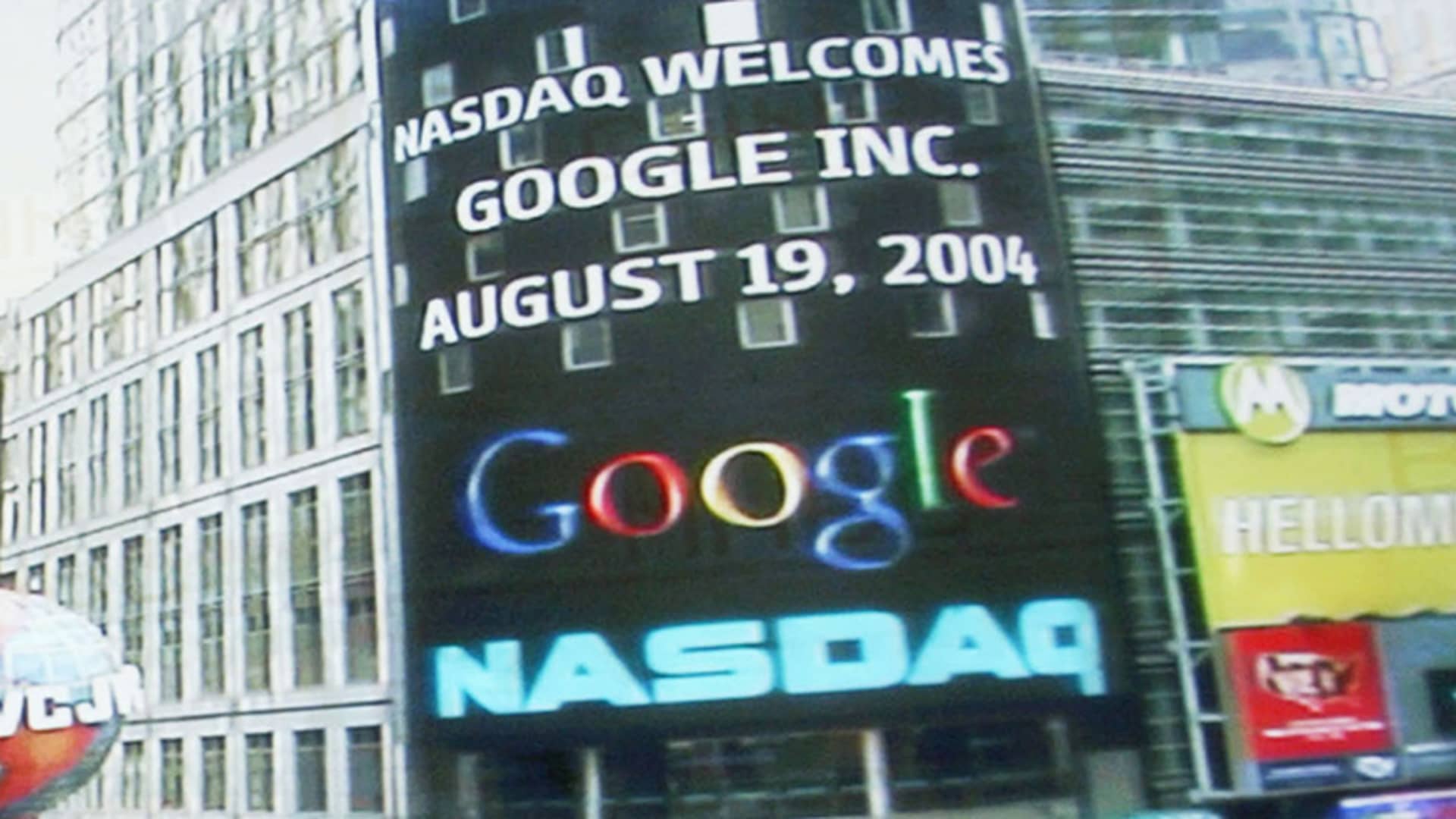

Twenty years ago, when Morgan Stanley Banker Michael Grimes helped to plan the IPO of the young company behind the Google search engine, one of the most eagerly awaited IPOs of the decade, he was one of the first to be offered a new email service. He could choose the identifier he wanted, so he asked for michael@gmail.com.
Sergey Brin, co-founder of Google, intervened. Grimes remembers Brin telling him, “Oh no, you don't want that. Gmail is going to be big. You're going to be bombarded with spam forever.”
Grimes told CNBC he regretted giving out the email address, but the IPO helped cement his reputation as “Wall Street's Silicon Valley whisperer” just as the tech industry was beginning to reshape global investing.
He describes the IPO of Google, whose shares have grown 7,600 percent over the past two decades, as “significant.”
The cumulative market value of the companies Grimes has taken public is in the trillions of dollars. Some have been more turbulent, like on facebook.in 2012, and some have pioneered innovative new structures, such as Spotify's direct listing in 2018. But Google's was groundbreaking.
“This was the beginning of a new era,” said Grimes. “Google [and other megacaps that followed] have changed the way we work, live and play. They've done it on a larger scale than any of us realized, and now these trillion-dollar companies are at the forefront.”
The company, now operating under parent company Alphabet, is worth more than $2 trillion. The tech giant no longer offers only search engines and advertising, but also includes YouTube, Pixel smartphones, cloud computing, self-driving cars and generative artificial intelligence among its many business areas. The technology company is so expansive that the Justice Department may be considering a split.
Alphabet was initially unavailable for comment.
When Google went public 20 years ago, the tech industry was still struggling with the fallout from the dot-com bubble of the early 2000s and investors were cautious. Instead of a traditional IPO, Google opted for a process called a “Dutch auction” that was intended to democratize the IPO and allow a wider range of investors to participate.
The founders' letter began with the words: “Google is not a conventional company. Nor do we intend to become one.” It also introduced Google's “Don't be evil” philosophy.
Grimes said Brin and Larry Page wanted equal conditions for their IPO: “Their position was: Wait a minute, if a young engineer sells some of her vested shares, Cisco or wherever, and she wants to invest $10,000 in Google, why tell her she's only getting $500 or nothing at all? Especially if she's willing to pay a dollar more than the institution.”
“Auction allocations,” Grimes said, “would be determined by price and size. Not by who you are, and that was the fun part. That was the fundamental breakthrough.”
Grimes added that some banks and institutions had warned the Google co-founders about the unusual procedure, telling them it was not the way to do things. But others, like his team, said they would work with them.
Winning the coveted “left lead” in an IPO was and is a tough battle. The Morgan Stanley team took on this format, built a prototype and tested a billion bids.
For the roadshow, they split into three different teams. Co-founders Brin and Page each led their own and CEO Eric Schmidt led the third.
By most accounts, the IPO was a success. Google defied a weak IPO market and an untested offering model to post a solid first-day return and a market capitalization of over $27 billion. From there, the stock continued to rise in value.
But it would take more than a decade for the principles behind Google's IPO to take off. Consumer technology brands like Facebook (now Meta), Twitter (now X), and LinkedIn (now owned by Microsoft) took the traditional IPO route. But some of the high-profile IPOs between 2019 and 2021 included elements that aligned with Google's democratization intent. Airbnb offered the hosts the opportunity to buy shares at the IPO price. Above And Lyft provided shares to its drivers and Robinhood gave customers access to its IPO.
Assessing the impact of Google's “don't be evil” credo and its aging is more difficult. Grimes declined to talk about today's Google because he can't talk about customers.
Google is now accused by US and European regulators of stifling innovation. And while the company is leading the shift to generic AI platforms, its search and advertising businesses – still its most important industries – are facing their biggest existential threat in decades.
Comments are closed.