
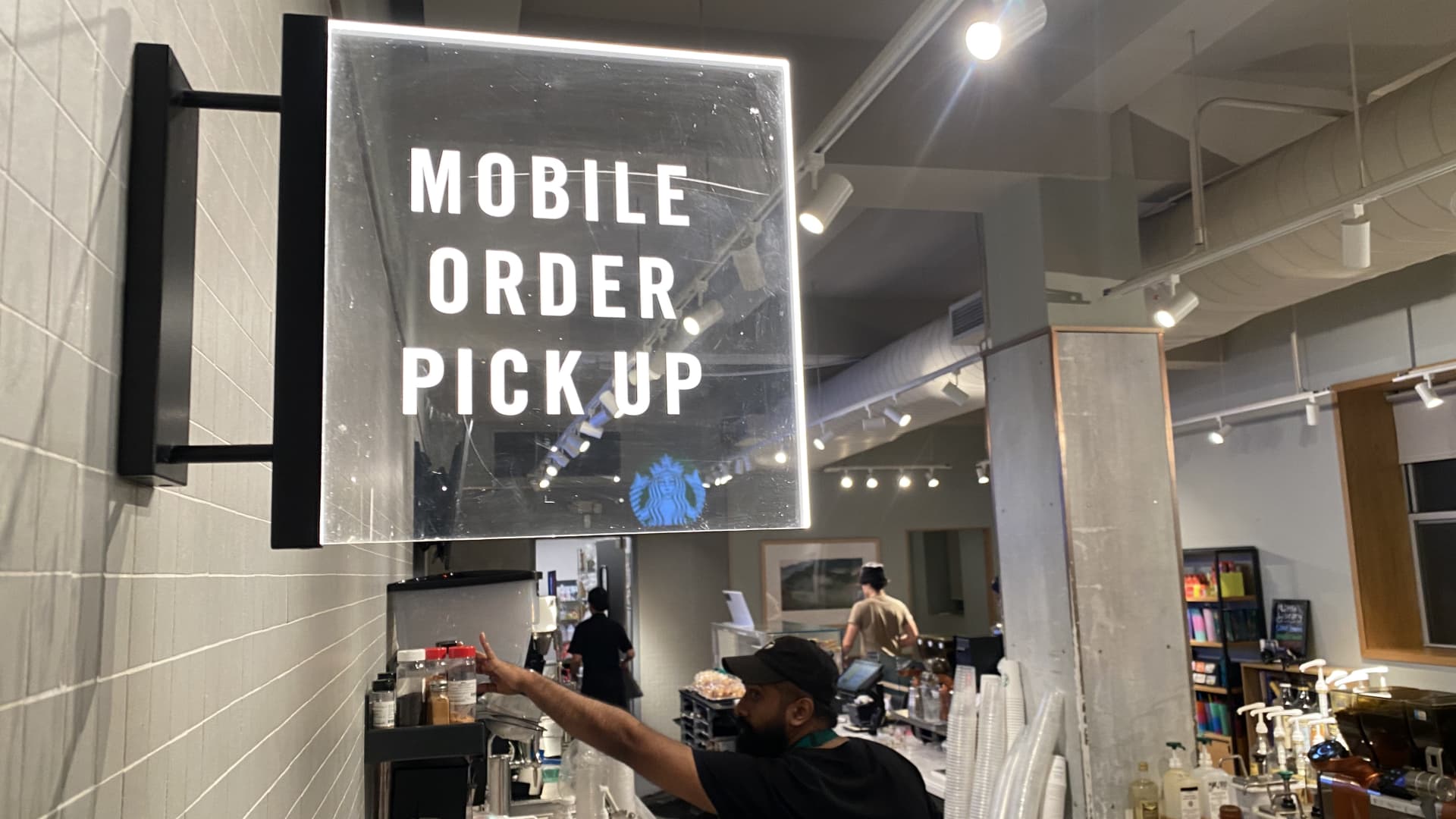

Mobile ordering and pickup area for Uber Eats and Doordash deliveries at Starbucks cafe, Queens, New York.
Lindsey Nicholson | Universal Images Group | Getty Images
It has become a familiar sight at Starbucks Cafes: a counter full of mobile orders, frustrated customers waiting for their ordered drinks and overwhelmed baristas trying to keep up with it all.
Solving this problem will likely be at the top of the to-do list for new CEO Brian Niccol, who aims to get the struggling coffee giant back on track when he takes office on September 9.
Investors and executives cite operational problems as one reason for the chain's declining sales in recent quarters. Other reasons for the recent drop in store sales include weaker consumers, boycotts and the decline of the Starbucks brand.
Former CEO Howard Schultz, who has no official role at the company but remains involved, has also pointed the finger at the mobile app, saying in an episode of the podcast “Acquired” in June that it had become “the biggest Achilles heel for Starbucks.”
Mobile orders account for about a third of Starbucks' total revenue and are typically more complicated. While add-ons like cold foam or syrup are more profitable for Starbucks, they tend to take up more of the baristas' time, frustrating both them and customers.
“I agree with Howard Schultz,” said Robert Byrne, senior director of consumer research at Technomic, a restaurant research firm. “It's not in the data – it's in the store. And that's the problem.”
Keeping pace with mobile growth
At the end of April, current CEO Laxman Narasimhan said the company was struggling to meet demand in the mornings – and was driving away some customers with long wait times.
Schultz said he experienced the problem himself when he visited a Chicago location at 8 a.m.
“Everyone shows up, and all of a sudden we have a mosh pit, and that's not Starbucks,” Schultz said on the episode “Acquired.”
One of the key ways Niccol can reduce crowds at Starbucks is by making mobile ordering more efficient.
When Schultz built Starbucks into the coffee giant it is today, he positioned it as a “third place” between work and home. Since then, the chain has lost that reputation as more customers embrace the convenience of mobile ordering and prefer not to linger in cafes.
“Because it’s a beverage and I often drink it in the car or on the go, it has to be incredibly convenient,” said Byrne.
However, Starbucks has not made any significant operational adjustments to prepare for this change in consumer behavior.
In 2017, Schultz stepped down as CEO for a second time, handing the reins to Kevin Johnson. Before joining the coffee chain as chief operating officer, Johnson was CEO of technology company Juniper Networks. Under his leadership, Starbucks invested in technology and continued to grow digital sales, but the restaurant operation was already struggling when he left the company.
Schultz stepped down as interim CEO when Johnson retired in 2022.
“The company did not properly anticipate the technical improvements that should have been made to prevent what happened. … The stock was at a record high, the company did not invest proactively and did not pay attention to the speed of the mobile app and its development until it was too late,” Schultz said.
Shareholders have also felt the frustration over digital ordering – and see this as a critical area that Niccol must address.
“The problem in New York City, for example, is the wait time,” says Nancy Tengler, CEO and chief investment officer of Laffer Tengler Investments, which owns shares in both Starbucks and Chipotle. “And then mobile orders take priority over in-store orders.” [Niccol’s] We need to somehow reverse this so that people spend more time in stores and spend more money.”
The problems with mobile ordering have increased pressure on baristas. Burnout, fueled in part by the app, has inspired some employees to unionize starting in 2021.
In November of this year, Starbucks Workers United, which now represents workers at about 450 of the chain's U.S. stores, urged the company to disable mobile ordering during ongoing promotions. (Starbucks said at the time that it was already in the process of enabling the change.)
Channeling the strength of Chipotle
Digital sales is no longer the same albatross for Niccol’s current employer, Chipotle.
Last quarter, 35% of the company's revenue came from online orders. The pandemic has sparked a continued shift toward online ordering, as the share of digital orders has jumped from 18% in 2019.
When Niccol joined Chipotle in 2018, most restaurants had already set up a second prep line for digital orders to avoid bottlenecks as online sales became increasingly important to the company. That same year, the company also began setting up drive-thru lanes just for picking up online orders, which it calls “Chipotlanes.”
In his six and a half years at Chipotle, Niccol and his executives boosted digital sales through a variety of promotions: favorite orders from sports stars, limited-time offers, a rewards program and the long-awaited launch of quesadillas. Quesadillas, in particular, became a digital-only option because they would have otherwise slowed down operations.
Chipotle also tested automating the production of burrito bowls, which can be ordered through its mobile app, through a partnership with robotics company Hyphen.
Mobile makeover
Starbucks has taken steps to speed up service and improve the barista experience.
In 2022, under Schultz's leadership, Starbucks introduced a reinvention plan that included eliminating bottlenecks with new equipment and other measures to speed up service.
Narasimhan has largely stuck to that strategy. Since February, the mobile app has finally shown customers the status of their orders, giving them a better idea of when their drink will be ready. And in late July, Starbucks rolled out its Siren Craft System across North America, a set of processes designed to make drinks faster and make baristas' jobs easier.
But Starbucks' problem may require more drastic measures.
For example, the rollout of the machines has been slow: About 40% of North American locations are expected to install the new machines by the end of fiscal year 2026. Accelerating that schedule could halve service times – as promised at the 2022 Investor Day – and reduce the burden on baristas.
“It is not an easy task to do this, it will require time and training and investment and [capital expenditure]said Andrew Charles, analyst at TD Cowen.
“We believe Brian has tremendous credibility. If he can tell investors, 'This is the answer to our problem,' and explain why he believes that, he will get through,” Charles said.
Comments are closed.