
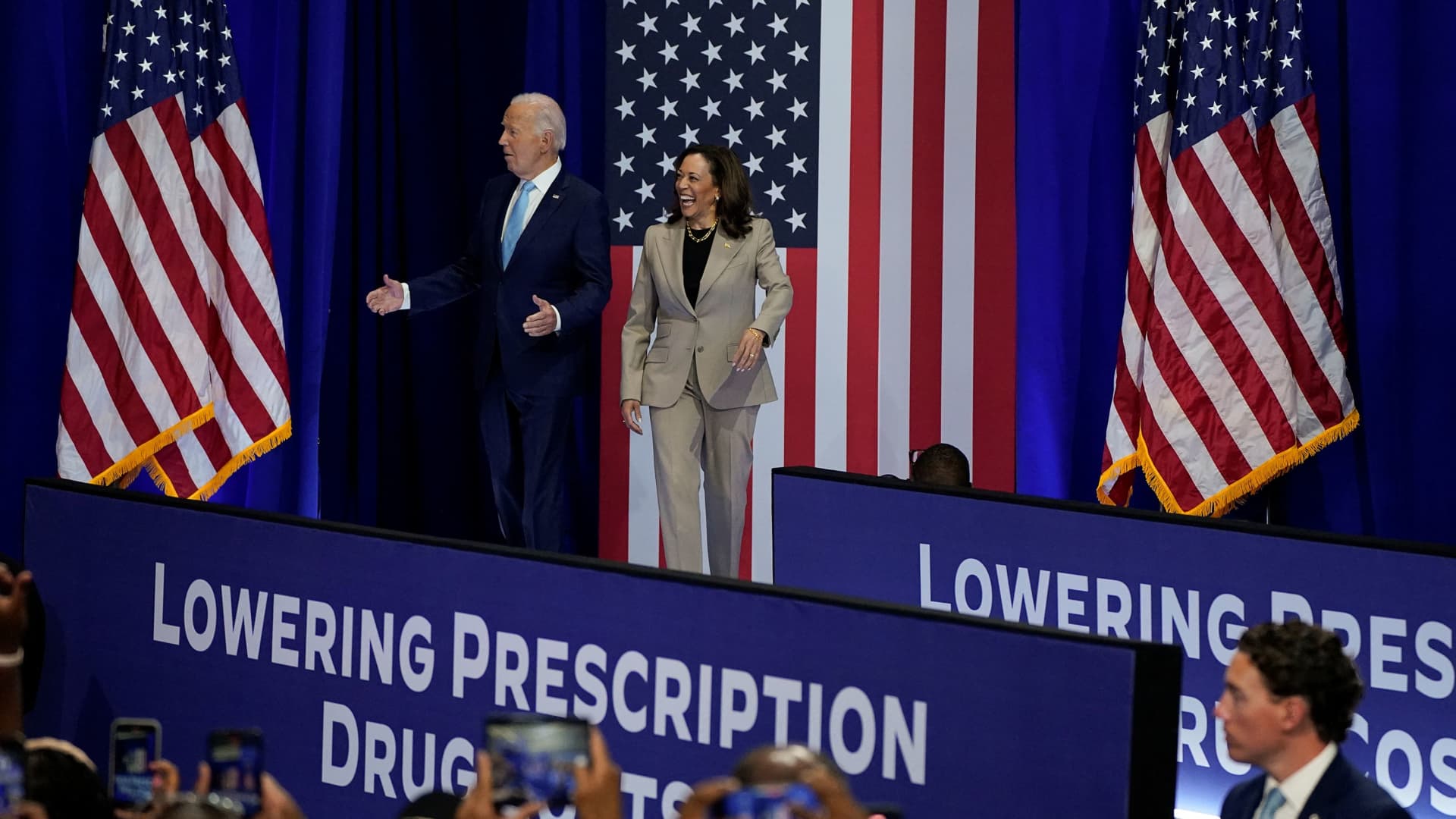

U.S. President Joe Biden and Vice President Kamala Harris leave a Medicare drug price negotiation event together in Prince George's County, Maryland, USA, on August 15, 2024.
Ken Cedeno | Reuters
The Biden administration on Thursday reached a milestone in Democrats' decades-long effort to use Medicare to lower prescription drug costs by announcing new prices for the first 10 drugs negotiated between the federal program and drugmakers.
But the announcement is just the beginning of a contentious, multi-step process that could save taxpayers and older Americans more money and, over time, put more pressure on drug companies. It's a key provision of the inflation-fighting bill signed by President Joe Biden, which took effect almost exactly two years ago.
The agreed prices, which will take effect in 2026, set a precedent for the next round of negotiations starting next year. These talks are likely to influence the prices of dozens of other widely used drugs from the world's largest pharmaceutical companies in the coming years.
“I think people should assume this is just the beginning. These are just the first 10 drugs,” says Leigh Purvis, a drug policy director at the AARP Public Policy Institute, an arm of the influential lobbying group that represents people over 50 and advocates for Medicare negotiating powers.
“Sometimes people get upset that their medication is not on the list, even though it will be on the list at some point in the future if they are taking a medication that has a high cost,” Purvis added.
It's unclear how much lower the negotiated prices are than the current net prices of the first ten drugs heavily discounted by Medicare Part D plans. These net prices aren't publicly available, making it difficult to know how much a Medicare plan and patient would actually save on a particular drug when negotiated prices take effect in 2026. Copayments could also vary depending on a patient's Part D plan.
“It's hard to know the starting point because … those numbers are not publicly available,” said Tricia Neuman, executive director of the Medicare Policy Program at the health policy research organization KFF, referring to net prices after rebates.
Nevertheless, the Biden administration estimates that the renegotiated drug prices will result in net savings of about $6 billion for the Medicare program and out-of-pocket savings of $1.5 billion for beneficiaries in 2026 alone.
Negotiations “seemed to go relatively smoothly — the overall savings are pretty impressive,” Neuman said. She added that the amount of savings will increase over time as prices for additional drugs are negotiated in future rounds.
Price negotiations could also put pharmaceutical companies under greater pressure in the coming years. Patent protection for many drugs in the first round of negotiations will soon expire. This will open up the market to cheaper generics, which in turn will lead to a loss of sales.
For example, Bristol-Myers SquibbThe pharmaceutical company's blood thinner Eliquis is set to lose its patent protection in the USA on April 1, 2028. In certain EU markets, patent protection for the successful drug will also expire in 2026.
But over time, drugs that are much further along in their loss of market exclusivity may be selected for future rounds of negotiations, Leerink Partners analyst David Risinger said in a research note on Thursday.
By February 2025, the Biden administration will select up to 15 more drugs that will be subject to the next round of price negotiations, with the new prices taking effect in 2027. Manufacturers have until the end of February to decide whether to participate in the program – a no-brainer for the companies, because if they don't participate, they face high excise taxes or loss of access to the federal Medicare and Medicaid programs.
“It's only going to get more painful as time goes on,” Jeff Jonas, portfolio manager at Gabelli Funds, said in a statement on Thursday. He noted, for example, that the next round of price negotiations will likely include: Novo Nordisk's best-selling diabetes drug Ozempic.
Jonas added that there was “some speculation that the government had been lenient with pharmaceutical companies this year because, on the one hand, it is an election year and this is the first time they have done something like this.”
After the second round, the Centers for Medicare and Medicaid Services will be able to negotiate prices for 15 more drugs that will take effect in 2028. Starting in 2029, that number will rise to 20 per year.
CMS will select only those drugs for Medicare Part D that are covered in the first two years of negotiations. For the round that takes effect in 2028, it will add more specialty drugs that are covered by Medicare Part B and are typically administered by physicians.
This could pose a greater threat to the pharmaceutical industry because prices for drugs under Medicare Part B are not as high as those for drugs under Part D.
“Because the discounts are limited, I expect they will continue to decline compared to the heavily discounted Part D drugs,” Risinger said in an interview with CNBC, referring to drugs covered by Part B.
Jonas noted that negotiations on price changes in 2028 could include some important cancer drugs, such as Merck's blockbuster chemotherapy Keytruda.
Vice President Kamala Harris, the Democratic presidential candidate, will likely try to expand the negotiating room and “probably be more aggressive on the discounts” if elected, Jonas said.
But Neuman said it will depend on which party controls the House and Senate whether they can pass legislation to strengthen that policy. Harris herself had to cast a tie-breaking vote in the Democratic-dominated Senate to pass the original bill.
“There is some interest from Democrats in Congress to get this done, but of course the law will depend on which party is in control,” Neuman said.
The pharmaceutical industry argues that the negotiations could lead to a loss of sales and profits as well as a loss of innovation in the long term.
For example, Steve Ubl, CEO of PhRMA, the pharmaceutical industry's largest lobby group, said in a statement on Thursday that price negotiations could lead to a reduction in the number of treatments for cancer, mental illness, rare diseases and other conditions because they “fundamentally change” the incentives for drug development.
Medicare can begin negotiating prices for small molecule drugs as early as nine years after FDA approval, compared to 13 years for biologics. Small molecule drugs are made from low molecular weight chemicals, while biologics are derived from living sources such as animals or humans.
The industry argues that this distinction will discourage companies from investing in small molecule drugs.
— CNBC's Angelica Peebles contributed to this report
Comments are closed.