
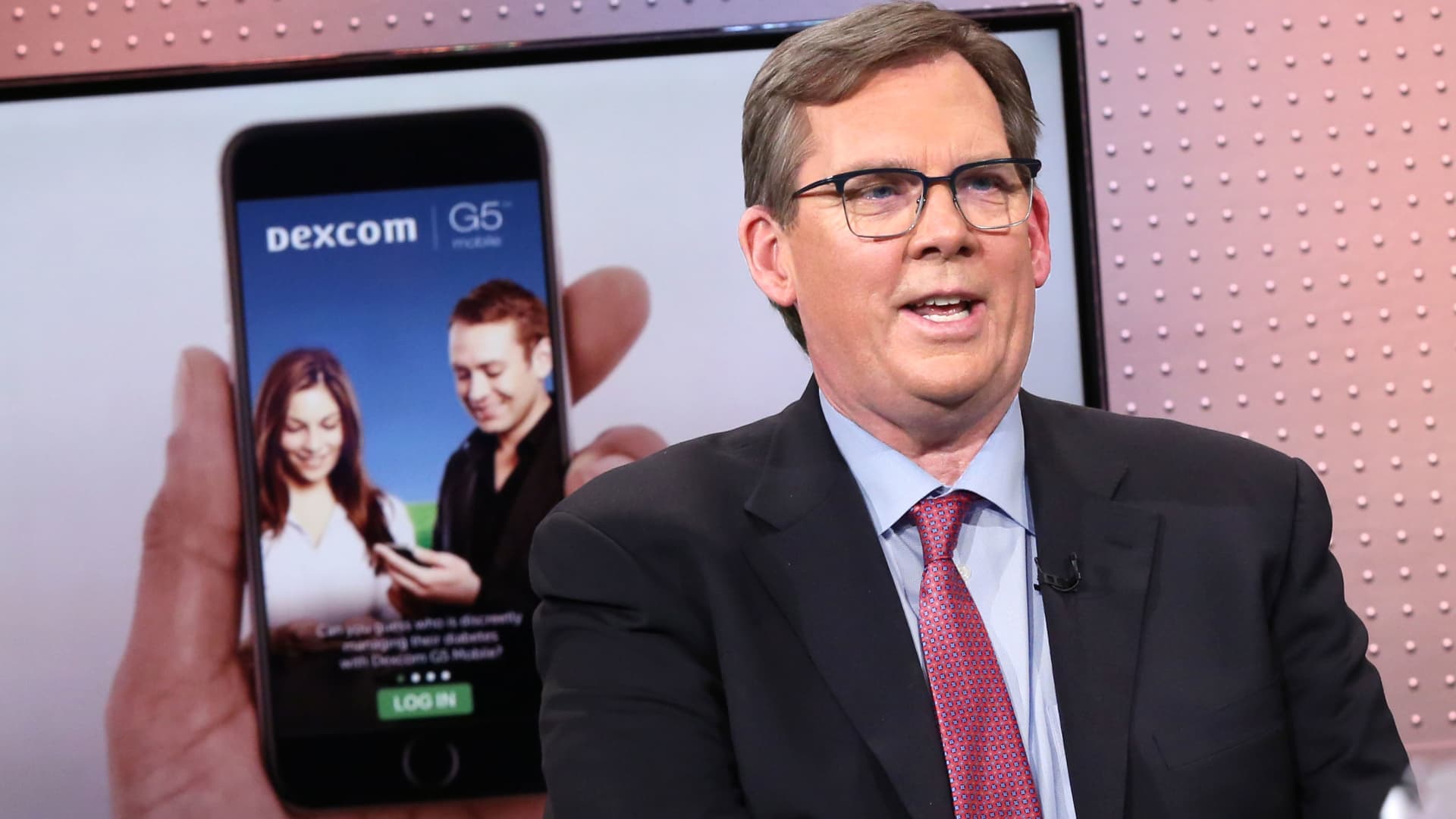

Dexcom Shares fell more than 40% on Friday, their sharpest decline yet, after the diabetes management company reported disappointing second-quarter sales and issued weak guidance.
The stock fell $43.85 to close at $64, wiping out more than $17 billion in market capitalization. Before Friday, the biggest drop came in September 2017, when shares plunged 33% in one day. Dexcom made its stock market debut in 2005.
Dexcom's revenue rose 15% to $1 billion from $871.3 million a year earlier, according to a press release late Thursday. Analysts had expected revenue of $1.04 billion, LSEG said.
Investors' bigger concern was the forecast. For the third quarter, Dexcom expects revenue of $975 billion to $1 billion to “account for certain one-time items impacting seasonality in 2024,” the press release said. Dexcom updated its full-year forecast and now expects revenue of $4 billion to $4.05 billion, compared to the $4.20 billion to $4.35 billion it forecast last quarter.
Dexcom offers a range of devices such as continuous glucose monitors (CGMs) for patients diagnosed with diabetes. On the quarterly earnings call, CEO Kevin Sayer attributed the difficulties to a restructuring of the company's sales team, fewer new customers than expected and lower revenue per user. Part of the shortfall was due to customers taking advantage of discounts on the new CGM called the G7. In addition, the company said it underperformed in the durable medical equipment (DME) space.
“DME distributors remain important partners in our business, and we did not execute well on those partnerships this quarter,” Sayer said on the conference call. “We need to refocus on those relationships.”
JPMorgan Chase & Co. Analysts downgraded the stock from a buy to a hold on Friday, saying the report represented a “sharp turn in the wrong direction.” The analysts said they still had some unanswered questions but were convinced the company's performance was due to internal issues and not related to market changes such as the rising popularity of weight-loss treatments called GLP-1.
In the question-and-answer portion of Thursday's conference call, JPMorgan's Robbie Marcus asked for more details on the significant reduction in forecasts and said he was “shocked” at how much disruption a change in the structure of the sales team could cause.
“I feel like there’s more that needs to happen,” Marcus said, asking if GLP-1 had an impact.
Sayer responded that the company is “missing a larger number of new patients than we would have expected at this time.” He said the restructuring of the sales team, which resulted in changes in geographic coverage, was more dramatic than expected because doctors are now dealing with different representatives.
In their note, JPMorgan analysts emphasized “the magnitude of the downward movement” and said the fact that it “appears to be largely self-inflicted is simply difficult to comprehend in its entirety.”
Regarding DME's difficulties, Sayer said the company has lost customers “who have the highest annual revenue per year,” adding that eligibility for G7 rebates is three times faster than with the previous product, G6.
Jereme Sylvain, Dexcom's chief financial officer, said all of these variables added up to a $300 million shortfall compared to the company's annual forecast.
“It's certainly not something we're happy about,” Sylvain said. He said that in the interest of “complete transparency,” the company needed to provide clarity on “what impact this will have for the rest of the year.”
Analysts at William Blair wrote that Dexcom's results were “disappointing” but their long-term view remains unchanged. Dexcom has the ability to expand the market and recover recent market share losses, they said.
“This short-term dynamic is likely to prove temporary,” they wrote in a statement on Friday.
Leerink analysts agreed, writing in a report Friday that the “magnitude of the sell-off is overdone” and that the issues currently hurting the company are unlikely to have a material impact on Dexcom's longer-term trajectory.
In March, Dexcom announced its new The over-the-counter CGM called Stelo has been cleared for use by the U.S. Food and Drug Administration. Stelo is designed for patients with type 2 diabetes who do not use insulin. Dexcom announced Thursday that it will officially launch in August.
Friday's sell-off has sent Dexcom shares down nearly 50% for the year, while the S&P 500 has risen 15%.
REGARD: Dexcom lowers forecast
Comments are closed.