

Marking with Synchrons BCI
Courtesy of Synchron
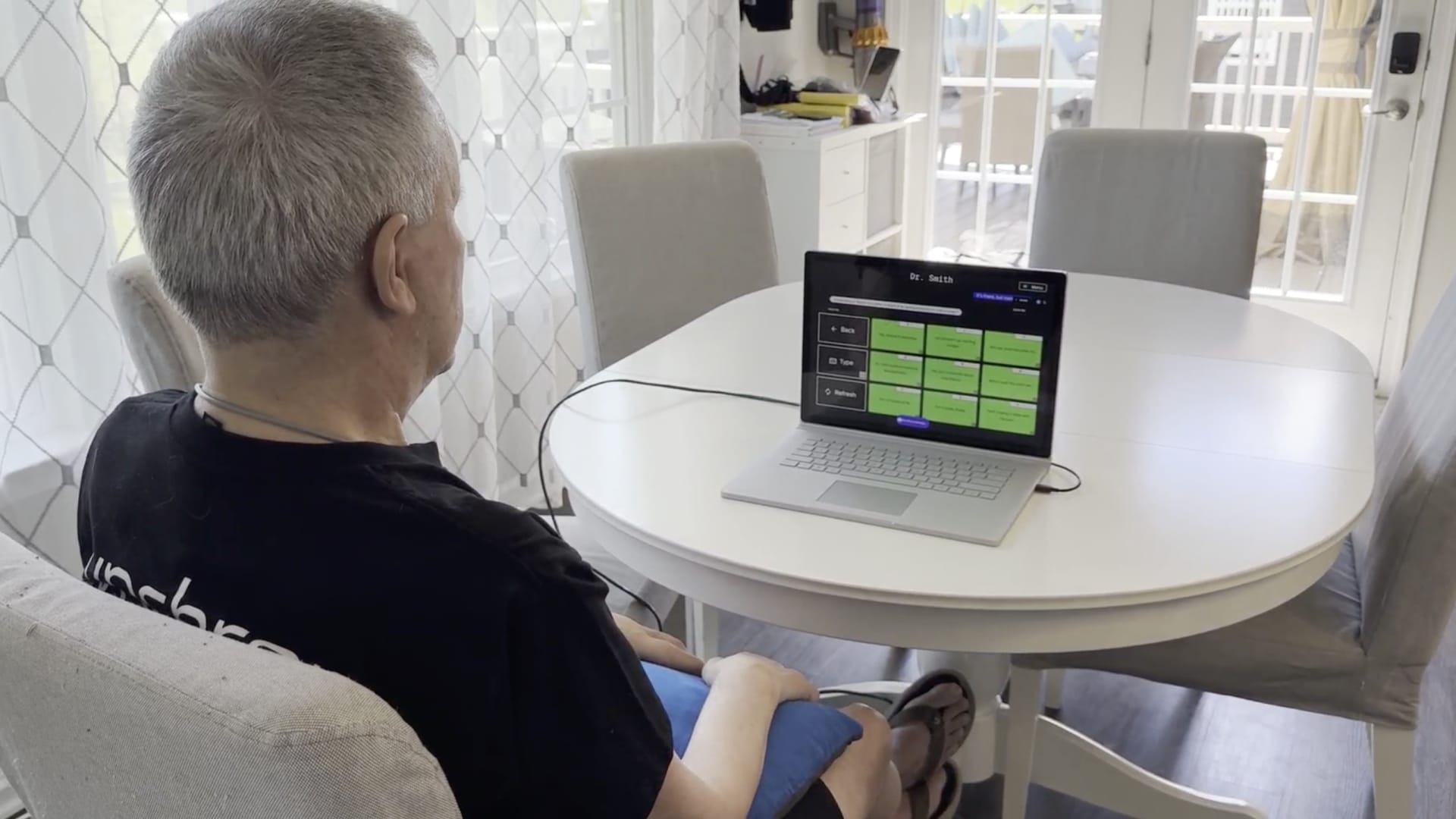
Mark, 64, has spent the last year learning how to control devices like his laptop and phone using a brain implant, and thanks to OpenAI, it's now much easier.
Neurotech startup Synchron announced Thursday that it is using OpenAI's latest artificial intelligence models to develop a new generative chat feature for patients using its brain-computer interface (BCI).
A BCI system decodes brain signals and translates them into commands for external technology. Synchron's model is designed to help paralyzed people communicate and maintain a degree of independence by controlling smartphones, computers and other devices with their thoughts.
The new AI chat feature can process text, audio and image input and generate prompts that patients can use when sending text messages, Synchron said. This way, the company can help people like Mark connect with the outside world more efficiently and naturally.
Mark, who asked CNBC not to use his last name for privacy reasons, was implanted with Synchron's BCI in August 2023. He suffers from the degenerative disease amyotrophic lateral sclerosis (ALS), in which patients gradually lose control of their muscles.
He said his diagnosis in January 2021 was like “a punch in the gut,” although in his case the disease progressed relatively slowly. Mark has difficulty moving his shoulders, arms and hands, but can still speak and walk short distances.
At some point he will lose these functions too, he said.
“Unfortunately, there's very little we can do. It's 100% fatal,” Mark said in an interview with CNBC on Monday. “But I knew from the beginning that I wanted to do everything I could to help future people with this disease.”
H/O: Synchron's AI-powered chat feature
Courtesy of Synchron
Mark has been testing Synchron's new chat feature on and off for the past two months. He said it helps him save valuable time and energy when texting. Using a BCI requires concentration and practice, so Mark said the AI helps take some of the pressure off of replying to messages.
“You have a choice of how you could respond in different ways,” he said. “Instead of typing individual words, I press one or two keys, or click if you will, and have the bulk of a sentence ready.”
For example, Mark can use the chat feature to schedule an appointment with his doctor and keep in touch with his daughters. He has worked in the flower industry for more than twenty years and said he recently used the tool to talk to a Synchron employee about gardening. It's a topic that has brought the two closer together.
Synchron CEO Thomas Oxley said the company takes a “pragmatic approach” to selecting the models that best support its patients' needs. Currently, that role falls to OpenAI, but Oxley said the two companies have not entered into an exclusive partnership. Synchron does not share brain data with OpenAI, he added.
Oxley said Synchron is still working on rolling out the new chat feature, but Mark helped pioneer it.
“For him, it's about preserving his autonomy,” Oxley said in an interview with CNBC. “The most important function of the BCI is to preserve his ability to make decisions.”
“Something bigger than yourself”
Mark works with a Synchron employee.
Courtesy of Synchron
BCIs have been studied in academic institutions for decades, but the commercial industry is still relatively new. Synchron, founded in 2012, is one of several companies such as Paradromics, Precision Neuroscience and Elon Musk's Neuralink that have been working on developing and commercializing BCI systems in recent years.
Neuralink is the best known company in the group thanks to the fame of Musk, who is also CEO of Tesla and SpaceX. But Musk isn't the only tech billionaire eyeing the field. In December 2022, Synchron announced a $75 million funding round that also included funds from the investment firms of Microsoft co-founder Bill Gates and Amazon founder Jeff Bezos.
Synchron's BCI is a stent-like device that is inserted through the patient's jugular vein. It is inserted into the blood vessel that lies on the surface of the brain's motor cortex. Because Synchron's approach does not require open brain surgery, its system is less invasive than those of competitors such as Neuralink and Paradromics.
As of July, no BCI company had received approval from the U.S. Food and Drug Administration to commercialize its technology.
In Synchron's case, the company has implanted its BCI in six patients in the U.S. and four patients in Australia as part of clinical trials. Mark was patient No. 10. Oxley said Synchron is currently preparing for a large-scale trial with more patients.
Mark learned about Synchron from one of his doctors as he was nearing the end of a drug trial he was participating in in August 2021. Deciding whether to get a BCI was a big decision, but he was convinced it would help him maintain some independence and ensure he could continue to communicate with his loved ones.
“That was the exciting thing for me – the ability to have some degree of independence,” he said. “I mean something as simple as changing the channel on the TV without having to call someone to operate the remote for you.”
He meets with Synchron twice a week for two hours to practice various skills and functions with the BCI. It takes a while to get everything set up and connected, so Mark uses the system mainly during these sessions. He also occasionally practices on weekends.
Mark said he doesn't use Synchron's new chat feature every time he uses the BCI. He's still learning how to navigate the prompts, but he's impressed by how often they reflect what he would normally say in a conversation. They even occasionally include swear words, he joked.
Mark had to stop working due to his illness and said that mastering the BCI helped him find a goal to strive for.
“It’s an opportunity to really be part of something bigger than yourself,” he said.
Comments are closed.